
Written by:

OLH: Histories of Private Environmental Law: part IV – Fire
 Reading time: 9 minutes
Written by:
Inglis v. Shotts Iron Co., (1881) 8 R. 1006 & (1882) 9 R. (H.L.) 78
The subject element here is fire, as theme for this fourth in a quartet of weekly studies of private law in defence of nature.
At night from atop the Pentland Hills, Midlothian’s street-lights almost describe a geological map of its coalfield. The coal measures dip like a shallow bowl under the heart of Midlothian, surfacing at angles, which to the east are gentler, but steeper at the western margin. There the ‘Edge Coals’ surface in long strips, running nor’-nor-east by sou’-sou’west from Niddrie to Penicuik. Or they did until the superficial measures were dug out, from mediaeval times on. After that, the mines chased the steep seams underground. In the parish of Glencorse the miners also met ironstone.
So in 1865 the Shotts Iron Company came east from Lanarkshire, to exploit the combination of coal and iron ore. The coal was the fuel for ‘calcination’: the process of baking ironstone with a restricted oxygen supply to drive off impurities; igniting coal with ore within the heaped spoil of a bing. The company reckoned the prospects worth the £5 million (in our money) that it laid out on infrastructure, from buildings to railways, even before work commenced.
The poisonous quality of the resulting fumes was foreseeable. The Shotts Company’s landlords, the Clerks of Penicuik knew a bit about science; James Clerk Maxwell was a cousin. The leases required all calcining to be removed at least two miles from Penicuik House. In other words, as close as possible to the neighbours.
As so often, it was the neighbours that were the problem.
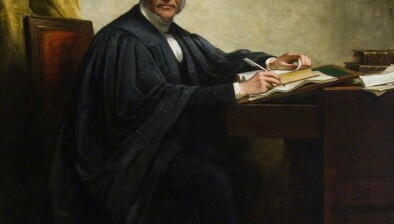
Lord President Inglis was far from the first Edinburgh advocate to invest his fees in a Lothian estate. He took his cue from his father, the minister of Greyfriars, who had acquired Loganbank at Glencorse. As Dean of Faculty in the 1850s, John Inglis bought the estates of House o’ Muir and Glencorse itself, with its fine 1812 mansion. Later he added neighbouring Bellwood, and inherited Loganbank; altogether several square miles of prime lowland farm- and woodland.
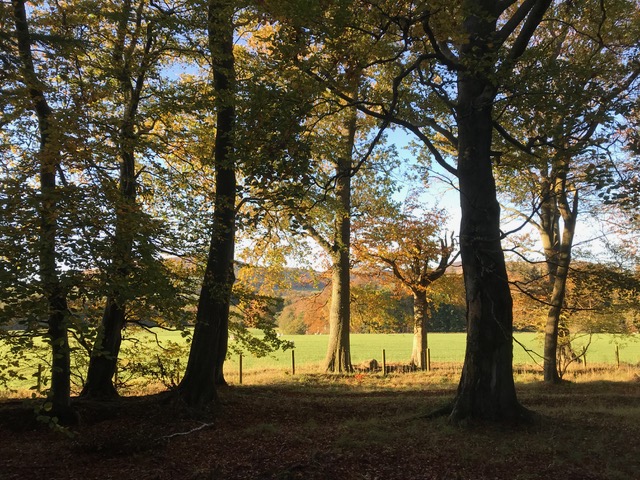
But they were only so by the vision and money of the gentry, and the hard labour of a myriad nameless countrymen. In the eighteenth century, much of central Midlothian had still been bleak moors and quaking bogs. Field drainage and silviculture are not to be taken for granted. John Trotter had begun planting the woods of Glencorse from the 1780s to the 1810s. Inglis took up Trotter’s work with enthusiasm.
According to taste, some may think the Lord President’s greatest gift to Scotland are his judgments; others, his noble beech woods. Nor our own hardwoods only: Inglis’s redwood sequoias can still be seen for miles across the county, over-topping the native trees. Inglis took a keen interest in exotic species. He started planting at Glencorse less than a decade before his nephew by affinity, Osgood Mackenzie, began the famous woods of Inverewe in Wester Ross. The two inheritances intertwined: it was at Sir Maxwell Mackenzie Inglis’s door that our father still remembers knocking monthly, to pay the rent at Glencorse when we were lads; John’s great-nephew. Inverewe surely has roots in Glencorse.
But trees and industry have a love-hate relationship. In November 1878 the Shotts Company ignited the bings at Mauricewood and Greenlaw; the latter just a hundred yards from Inglis’s head forester’s house. The prevailing sou’westerlies took the grey, noxious, slowly coiling fumes across the parish, “to enter the woods and to lie there in huge heavy masses”. Fumes leaving an acrid taste rolled visibly as far as Glencorse Old Kirk; “immense quantities of clouds” of smoke drifted over Flotterstone, Milton Bridge and beyond.
The judicial trees began to be poisoned; leaves were scorched and growth stunted. This grew. The Lord President gave commands. Then all smiles stopped together, with proceedings for interdict served in October 1880, followed by the unusual appearance of the Lord President as the opening witness in a proof in the Court of Session. Lord Rutherfurd Clerk was invited to grant interdict against the company from calcining ironstone anywhere within two miles of Lord Inglis’s marches.
Without the manifest benefits of modern case-management, or modern communications, the proof heard seventy-one witnesses over two weeks (plus three on commission). Contrary to ideas that the proliferation of experts is a twenty-first-century phenomenon, fifty-six men of skill testified: twenty-eight foresters, fourteen chemists, eight botanists, three mining engineers, a meteorologist, a surveyor and a rates assessor. Professors from Aberdeen, Cambridge, Chemnitz, Dublin, London and Oxford appeared, among them no fewer than five Fellows of the Royal Society.
It was a hard-fought journey over the mapped-out routes of the smoke plumes, by way of evidence of plantations, species, and seasons, as well as much wider British experience of calcination’s effects on woodland. Rain-water collected across the estates was analysed, alongside experimental exposures of saplings to sulphates.
Clearly Inglis’s team used his contacts in the world of forestry to advantage. But the defence responded with seventeen foresters to Inglis’s eleven, affecting to be comprehensively scathing about the Lord President’s planting and management of his woods. They blamed over-crowded and over-shaded trees, bad soil and poor drainage, plus the unusual Scottish features of cold and wet weather. Special weight was placed on the fact that “the injury does not diminish in proportion to the distance from the bing; that trees which are near escape, while those at a greater distance are said to be injured”.
The judges at all levels were more impressed by the calculations that Shotts’ process had yearly released into the air about 360,000 lbs. of vaporous sulphurous and sulphuric acids, and “the immediate and marked change for the worse which took place a few months after the calcining commenced”.
In the Outer House, Lord Rutherfurd Clerk took the matter to avizandum for a fortnight. On 18th March 1881 he granted interdict against the calcination fires. The ban did not extend to the two miles sought in the summons, but compromised at one. That would have been a success for the defence, had not the bings all lain within the mile. Maybe the Lord President’s juniors’ (Trayner and Graham Murray) conclusion for two miles was never more than shrewd pleading.
At the proof, the defence had accepted that the case turned on the facts, raising no issue of law. Having lost, they then back-pedalled to the Inner House, arguing that “What they were doing was merely using the mineral products … in the only way in which they could be used … what [their opponents] were finding fault with was an industry not uselessly thrust upon them, but necessary to develop the resources of an adjoining property.” And anyway the proper remedy was damages. (Though not cited, that had been the outcome of comparable West-Lothian case of Chalmers v Dixon, (1876) 3 R. 461.)
The Inner House had the decency to send the case to the Second Division. Lord Justice-Clerk Moncreiff held:
“The simple ground of complaint … relates, not to any use which the defenders make of their own property, but to the use which they make of the atmosphere as it passes over them, by injecting into it noxious vapours, which prevent it reaching the pursuer in purity, and cause damage to his property. The law on this subject was fully discussed and settled in the case of a running stream, in the action against the papermakers on the Esk [discussed here last week]. The analogy of the atmosphere may not be in all respects complete … But in the case of injury to health by polluting the air the regulating principles are precisely the same”.
Nothing daunted, Shotts went to London. For the appeal to the Lords they retained the Attorney-General. Inglis countered with the joint instruction of the Lord Advocate and the Solicitor-General for England.
Lord Chancellor Selborne’s illuminating discussion of the chemistry and forestry suggests less any real relevance of re-weighing the evidence in a second-level appeal, than the fact that he just found it all really interesting. The appellate panel were unanimous for Lord Inglis.
It would be unfair to take the case as authority for the proposition that, if you are sued by the Lord President in his own court, then you are going to lose. But you might not blame the defenders for wondering. Of the eight judges concerned, from Outer House to the House of Lords, seven were for John Inglis. The cerebral George Young alone dissented in the Second Division, in a nuanced, fighting retreat.
As it fell out, the colliery’s end came not long after. In 1889, fire broke out in the mine. Sixty-three men and boys were asphyxiated, from John Walker, aged sixty-two, to Walter Meikle, twelve years old. In Penicuik “everywhere there were groups of women standing on the highway, wistfully looking in the direction of the colliery for the dismal train of body-laden carts which was the uttermost that many of them could hope to see”. Robert Louis Stevenson’s friend the Rev. Stanley Crockett, minister at Penicuik, led the relief efforts for the families.
Long after, as kids we played in the green woods, and in the fields above the forgotten mine-workings, oblivious of history, pollution and death. But even a child could not fail to notice how loath vegetation was to grow on the sterile bings, or their strange warmth. From out beneath Mauricewood Bing, the waters of the burn flowed orange, heated, unnatural. After nearly a century, the buried fires of calcination somehow still grimly burned. When in 1970 the bull-dozers rolled to remove the bings, the inrush of fresh oxygen raised spectacular sheets of flame high up into the air. “Dust in the air suspended marks the place where a story ended.”
And here we end the past four weeks’ recollections of early environmental law in Scotland. We began with Lord President Pentland’s forecast that litigation about environmental issues will become a greater feature of the work of the Scottish courts. If that comes to pass, then there may be benefit in drawing on the deep historical roots of the use of our private law to protect nature against man.

Share this article:

Subscribe to our newsletter to not miss articles like this one:
 SUBSCRIBE