
Written by:

OLH: Histories of Private Environmental Law: part III - Water
 Reading time: 8 minutes
Written by:
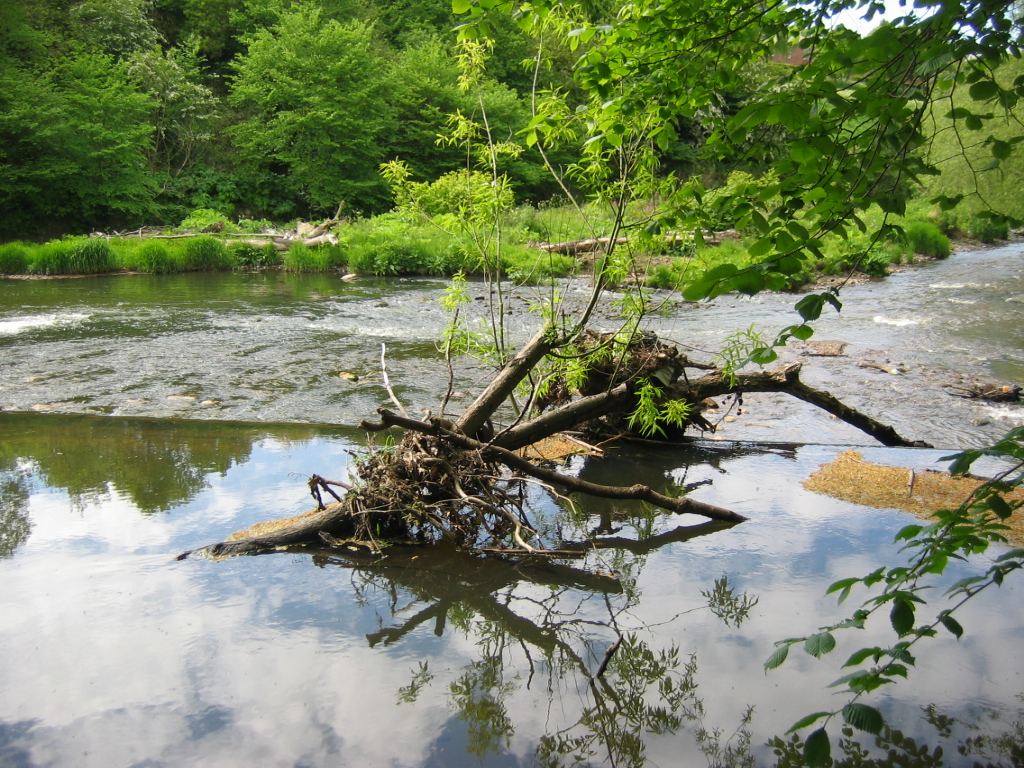
River Esk weir
Duke of Buccleuch v. Alexr. Cowan & Sons, (1864) 2 M. 653; (1866) 5 M. 214; (1866) 4 M. 475; (1867) 5 M. 1054; (1873) 11 M. 675; (1873) 1 R. 85; (1874) 1 R. 1111; (1876) 4 R. (H.L.) 14
To study environmental protection in private law, this third in a quartet of weekly tales starts with Ice Ages, which always end with centuries of melt-water lakes and fast-flowing rivers. From the thirteenth millennium before Christ, with the latest great thaw, these torrents carved our lowland landscapes, wearing steep little glens, like that which from Carlops to Dalkeith now carries the North Esk as a much tamer stream. In the eighteenth century, its haughs provided attractive building-sites beside the river’s water and energy. Edinburgh provided both rags as the raw material for paper and customers such as lawyers eager to have it. An industry was born.
Paper-making on the North Esk dates from at least 1709, from Penicuik downstream. By the mid-1800s, the district was such a world-leader in paper that the Japanese came to learn. Mechanisation replaced manual manufacture, at a price. In the 1830s the river was still good for trout, but they were leaving. Downstream from where Ramsay’s Gentle Shepherd had sung of halesome waters from crystal springs, it became not just an open sewer, but a snake of grey-brown soup with a loathsome smell, which even drouthy livestock spurned. The horrid story of Lothian’s nineteenth-century rivers is well told by Christopher Smout and Mairi Stewart in The Firth of Forth - An Environmental History. For human sewage, the Esk was not as gross as the Water of Leith (see Downie v Earl of Moray (1825) 4 S. 167 & (1827) 5 S. 912), nor its industrial wastes as toxic as those poured into the Almond, from the surface of which such gases then rose as a bold man could ignite into flame. But it was bad enough for men to go to law.
In 1841 in the Court of Session, a group of Midlothian land-owners sued several mill-owners for interdict against the pollution. They included the Duke of Buccleuch (the present Duke’s great-great-great grandfather), Viscount Melville (grandson of ‘Harry the Ninth’) and Drummond of Hawthornden (not in direct line from the homonymous poet; his grandmother had been sister-in-law to the poet’s great-grand-daughter). The water was averred to be “noxious or unwholesome”, “unfit for domestic use, or for the use of cattle” and exhaling “a stench … perceptible at a considerable distance”.
In 1843, on a remit, scientists proposed mitigations, to which the mills ostensibly agreed. The cause paused to judge them. But, in Lord Inglis’s words, “after a long series of years … these attempts were entirely unsuccessful … the pollution not only continued but was greatly increased.” In 1861 the mills began a new process, using Spanish esparto grass, boiling it in caustic soda (sodium hydroxide) and discharging the effluent into the river. In 1864 a core of pursuers awoke the old action and raised two more.
Up to ten counsel appeared at a time, both sides at one time or another retaining the lord advocate of the day, the defenders also the dean of Faculty. When matters reached the House of Lords the papermakers instructed Alfred Thesiger, QC, brother to the Lord Chelmsford who lost at Isandlwana, and great-uncle to the explorer. In that more liberal age, the Lords’ committee included Lord Gordon, who was well-qualified to judge, because at different stages below he had appeared as counsel for both sides. Already by 1867, when the cases still had nine years to run, in today’s money the pursuers’ expenses reached £600,000.
Preliminary issues were discussed; e.g., objection that some of the pursuers’ lands were actually upstream of some of the mills. Lord Ormidale held that, for the same wrong, multiple pursuers could sue multiple defenders in one action, because riparian proprietors have common interest in a river. (Common interest survives its statutory abolition in tenements to still regulate our inland waters: cf. Reid, ‘Common Interest’, 1983 J.L.S. 428.) The Second Division adhered. That procedural issue was the only one ultimately taken by the defenders in a failed appeal to the Lords, which concluded in 1876, a full thirty-five years after the litigation began.
In July 1866, by a majority of nine to three, the jury found for the land-owners.
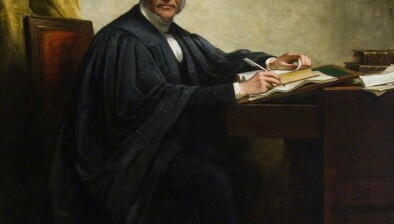
Much of the reports’ 56,000 words is of interest chiefly to the student of bills of exceptions to jury charges, how to set aside a verdict under the Act 55 Geo. III, and early discussion of certification of expert witnesses. Of more enduring interest is that, as with other Inner-House business in that age, the bench might include the judge whose decision was appealed. The Second Division considered objections to Lord Justice-Clerk Inglis’s jury directions, which John Inglis joined with his colleagues in rejecting.
To the defence that industry contributed to national wealth, Lord Inglis replied that a riparian owner could neither take water for public use, nor foul it for public benefit. Lord Neaves concurred:
“Suppose a man constructed a mill in which he manufactured the elixir vitæ, or an invaluable cure for the cholera, if he pollutes the stream I am entitled to stop him. I may … make myself an enemy of the human race … but I am entitled to do so.” Lord Neaves set forth the harm principle in terms which might have gladdened John Stuart Mill: “no man … is entitled to send over his neighbour’s land that which is noxious and hurtful, to an extent with sensibly diminishes … comfort and value … Now, if the taking away of the primary uses of water is not a visible and sensible injury … I do not know what is.”
The jury’s verdict, having been vindicated, was followed then by six more years of attempts to agree its effect, by dint of another remit to men of skill. Finally the pursuers’ patience was exhausted, and in June 1873 a succinct interdict granted against discharging “any impure stuff or matter … whereby the … water … may be … rendered unfit for domestic use, or for the use of cattle”.
The most general legacy of the North Esk case for the law of reparation throughout the English-speaking world is the principle that, for liability, it is unnecessary for a man’s wrongful conduct to have caused injury; it is sufficient that it contributed materially to the harm. As Lord Benholme said, “in this world there but few important effects … either in physics or in morals, that may not be said to have been occasioned by several causes”. Lord Inglis added, “it is no answer … to say, ‘Well, but other people are polluting it too’ … The plain answer to that is ‘Very well … stop your pollution, and then we will deal with the others’.” Otherwise a group could jointly do wrong with impunity, if the victim had to prove the action of each sufficed to injure him. (Whether the sufficiency of material contribution truly originated in the Second Division in December 1866 is a question for scholarship, which might consider hints from Lord Brougham in Ferguson v. Earl of Kinnoul, (1842) 1 Bell 662.)
In the long run, the outcome was mixed. A century later in the 1960s, when our father took us camping under Roslin Castle, there were still great bergs of industrial foam on the stream, caught up against the ruddy sandstones of the linn. At day’s start and close, then the mills’ sirens still sounded across Penicuik. Road-signs read ‘Welcome to the Paper-making Town’. But even before the last mill closed in 2004, they fell to sacked mill-workers’ resentful sledgehammers.
Now otters live on the North Esk, and you will see cormorant standing sentry on its stones.
The Second Division’s dismissal of the public-benefit defence summarily judged a controversy inherent in society: when can the common weal justify injury to individuals? Have we made progress since? SEPA oversees cleaner waters. For cause, how to distinguish between regulatory progress, and the conversion of Scotland into an unprofitable place in which to make the things that we once sold, and still wish to buy? Is talk of progress a “partial fallacy encouraged by superficial notions of evolution, which becomes, in the popular mind, a means of disowning the past”? The past has relevance and lessons. A lesson of the North Esk is that private law can help defend a green and pleasant land.

Share this article:

Subscribe to our newsletter to not miss articles like this one:
 SUBSCRIBE