

Written by:

Our Legal Heritage: The Oz trial
 Reading time: 9 minutes
Written by:
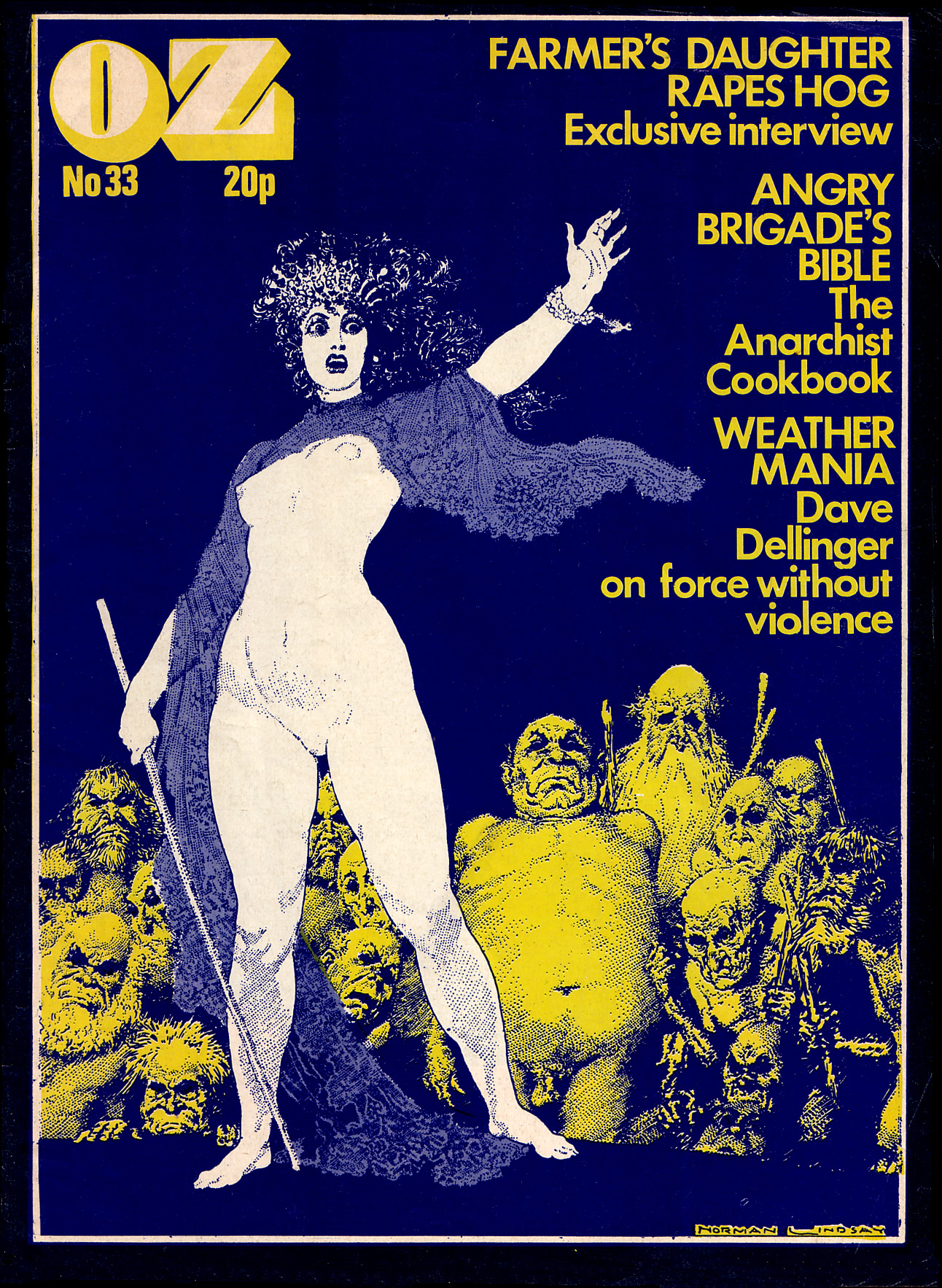
Oz (London) No.33, February 1971. Cover image by Norman Lindsay.
In part one of a retrospective on a notorious obscenity trial, sparked by a subversive depiction of Rupert Bear in the counter-cultural magazine Oz, Ronnie Clancy KC looks at how the case became a defining legal and cultural clash of the early 1970s, pitting establishment morality against claims of artistic freedom and exposing deep generational divisions in Britain.
In 1970 Rupert Bear was at the height of his fame. He was much loved by generations of Britons who were enchanted by his exploits as seen in the Daily Express comic strip published continuously from 1920 and in his Annuals, a mainstay of Christmas stockings from 1936. In May 1970 Rupert was cruelly used in an underground magazine called Oz. His head was superimposed on the body of a character engaged in explicit sexual activity in a lurid comic strip originally drawn by the American cartoonist Robert Crumb.
Oz was a monthly magazine first published in London in 1967 by three Australians who had previously published it in Sydney where they were twice prosecuted on obscenity charges. At the opposite end of the publishing spectrum from the Daily Express, Oz was the flagship of the counter-culture which flourished in the UK in this period. It was famous for its psychedelic artwork and its shocking copy. The contributors included Germaine Greer, Polly Toynbee and Auberon Waugh. This release was labelled the School Kids Edition. It was compiled by a group which included about 20 senior school pupils aged 15 to 18.
The Rupert strip (put together by a 15-year-old schoolboy called Vivian Berger) was one of many items, typical of the magazine, which dealt with sex, sexuality, drug taking, rock music, radical politics and other hot topics of the day.
The Obscene Publications Squad of the Metropolitan Police had previously raided the offices of Oz but no charges ensued. The School Kids Edition was the last straw and the three co-editors, Richard Neville, Jim Anderson and Felix Dennis, were charged with a number of offences. These were, a draconian common law charge of conspiracy to corrupt public morals (which carried a maximum sentence of life imprisonment), three charges under the Obscene Publications Act 1959 (publishing and possessing obscene articles for gain) and one contravention of the Post Office Act 1953 (posting obscene articles). This was the first time that a conspiracy charge was used in an obscenity case.
The case became a cause célèbre for a broad alliance of libertarians, free speech campaigners and hippies (self-styled freaks) of all kinds. Supporters of the magazine organised a protest march which was attended by many celebrities including John Lennon and Yoko Ono. They recorded and released a fund raising single record called God Save Us. It flopped. David Hockney created a lithograph in support of the magazine which was sold in a limited edition in a fund raising exhibition. Other works were donated by Andy Warhol and by two leading illustrators, Ralph Steadman and Gerald Scarfe.
The trial judge appointed to hear the case was Judge Michael Argyle QC. Educated at Westminster School and Cambridge University, he served with distinction in the Seventh Queen’s Own Hussars in the Second World War, winning the Military Cross in Italy. He twice stood unsuccessfully as a Tory candidate in parliamentary elections in the 1950s. In practice at the bar he defended Ronnie Biggs in the Great Train Robbery trial. On the bench he was known as a harsh sentencer. He made no attempt to conceal his social and moral conservatism. On one occasion he said to a witness: “You are far too attractive to be a police woman. You should be a film star.” On another he described a mugging victim as “a vicious little sodomite from Glasgow”. It is safe to assume that he was not an Oz subscriber.
The defendants appeared at the committal hearing dressed as schoolboys in caps, shorts and blazers. They paraded these costumes outside the court to the delight of a large press corps in attendance. No doubt Judge Argyle kept this stunt in mind for further consideration at the sentencing stage in the event of a conviction.
At the trial Anderson and Dennis were defended by John Mortimer QC (author of the Rumpole stories), who had successfully defended the publishers of Lady Chatterley’s Lover in an obscenity trial in 1960, and by Geoffrey Robertson. Neville defended himself.
The trial commenced at the Old Bailey on 23 June 1971 in a blaze of publicity and ran for 27 days. The defendants arrived at court accompanied by a carnival procession of young supporters which, according to The Times, “underlined the unbridgeable gap between generations”. This observation encapsulated the first of four main themes in the case. The second was mentioned in his opening speech by counsel for the prosecution, Brian Leary. Quoting from the terms of the conspiracy charge, he majored on the allegation that this edition of Oz was clearly directed at schoolchildren and that the defendants conspired to corrupt the morals of young people, “implanting in their minds all sorts of perversions and sexual depravity”. The third theme was raised in his opening remarks by John Mortimer who said that “[the case] stands at the crossroads of our liberty, at the boundaries of our freedom to think and draw and write what we please”. The fourth was the culture clash between the traditional morality which underlay the prosecution and the progressively minded, anti-establishment ethos of the magazine. Thus the battle lines were drawn.
The Crown case was brief. Speaking of Rupert Bear the prosecutor said that “you may be familiar with him but not in the guise in which he appears in this magazine”. Most of the first day of the trial was taken up with the jurors reading the magazine from cover to cover. In cross-examination the senior police officer, DI Frederick Luff, said that the magazine was undesirable from a family point of view and that it attacked society. Vivian Berger, who Mr Leary described as “an accomplice”, said that his motive for creating the Rupert cartoon was to shock the older generation. He said it was very funny, it was representative of the sort of artwork which was commonly circulated amongst school children. Somewhat unhelpfully for the defence he said in cross examination that “maybe I was portraying obscenity but I was not being obscene myself”.
About 20 days of the trial were taken up with expert evidence for the defence on two issues. First, on whether the content of the magazine was obscene. Second, in support of a defence under section 4 of the 1959 Act, whether publication was justified “as being for the public good on the ground that it is in the interests of science, literature, art or learning, or of other objects of general concern”.
On these matters the experts included the legal philosopher Ronald Dworkin, professor of jurisprudence at Oxford University. He said that “the prosecution was a corruption of public morals … .part of the public morality is freedom of expression”. The flamboyant jazz musician George Melly told the jury that Oz had a social function as “it helped to alleviate the guilt complex about sex”. The wild eyed comedian Marty Feldman caused a stir by concluding his evidence with the claim that “there is more obscenity to be found in the Bible than in this edition of Oz”. He expanded on this by referring to the frequent incidents of violence in the Bible. Other experts for the defence included the academic (and lateral thinker) Edward de Bono and the disc-jockey John Peel.
There was a third line of defence which was double-edged to say the least. It was that, assuming that the content was obscene, it was incapable of corrupting or depraving readers because it was so disgusting that it would repel them, it would have an aversive effect. Evidence on this, centred on his clinical practice, came from the psychologist Lionel Hayward.
In his closing speech Mr Leary made the lowering submission that the alternatives before the jury were “dropping out of society expecting the state to provide for you, and by that I mean you and me and those of us who do not mind work”. The defendants were not claiming social security benefits. John Mortimer told the jurors that “one man’s obscene article could be another man’s nursery rhyme” and that “if free speech means anything it means tolerance of people you do not agree with”. In his summing up the judge mentioned Marty Feldman’s evidence about the Bible and then quoted the parable of the sheep and the goats from the gospel of Saint Matthew – thereby strongly inferring that the comedian was a goat and would go to hell.
On 28th July 1971 the jury returned a ‘not guilty’ verdict on the conspiracy charge. The defendants were convicted of the three obscenity charges under the 1959 Act and of the postal charge. They were remanded in custody pending sentence, were taken straight to Wandsworth Prison and immediately shorn of their long hair.
At the sentencing diet eight days later a crowd of 400 supporters, including Tony Benn, staged a protest outside the Old Bailey. Neville and Anderson (both Australian) were jailed for 15 and 12 months respectively on the obscenity charges with recommendations for deportation. Dennis, who was English, got nine months on these charges. All three were sentenced to six months’ imprisonment concurrently on the postal charge. These sentences were widely criticised. They far exceeded the non-custodial sentences routinely handed down to hard core pornographers. Tony Benn tabled a Commons motion expressing shock at the severity of the sentences. An editorial in The Times declared that the sentences were justified because this edition was targeted at schoolchildren. As we will see, the Court of Appeal disagreed with that. Four days after sentencing the defendants were released on bail pending appeals.

Share this article:

Subscribe to our newsletter to not miss articles like this one:
 SUBSCRIBE