
Written by:

Our Legal Heritage: Oz – the appeal
 Reading time: 7 minutes
Written by:
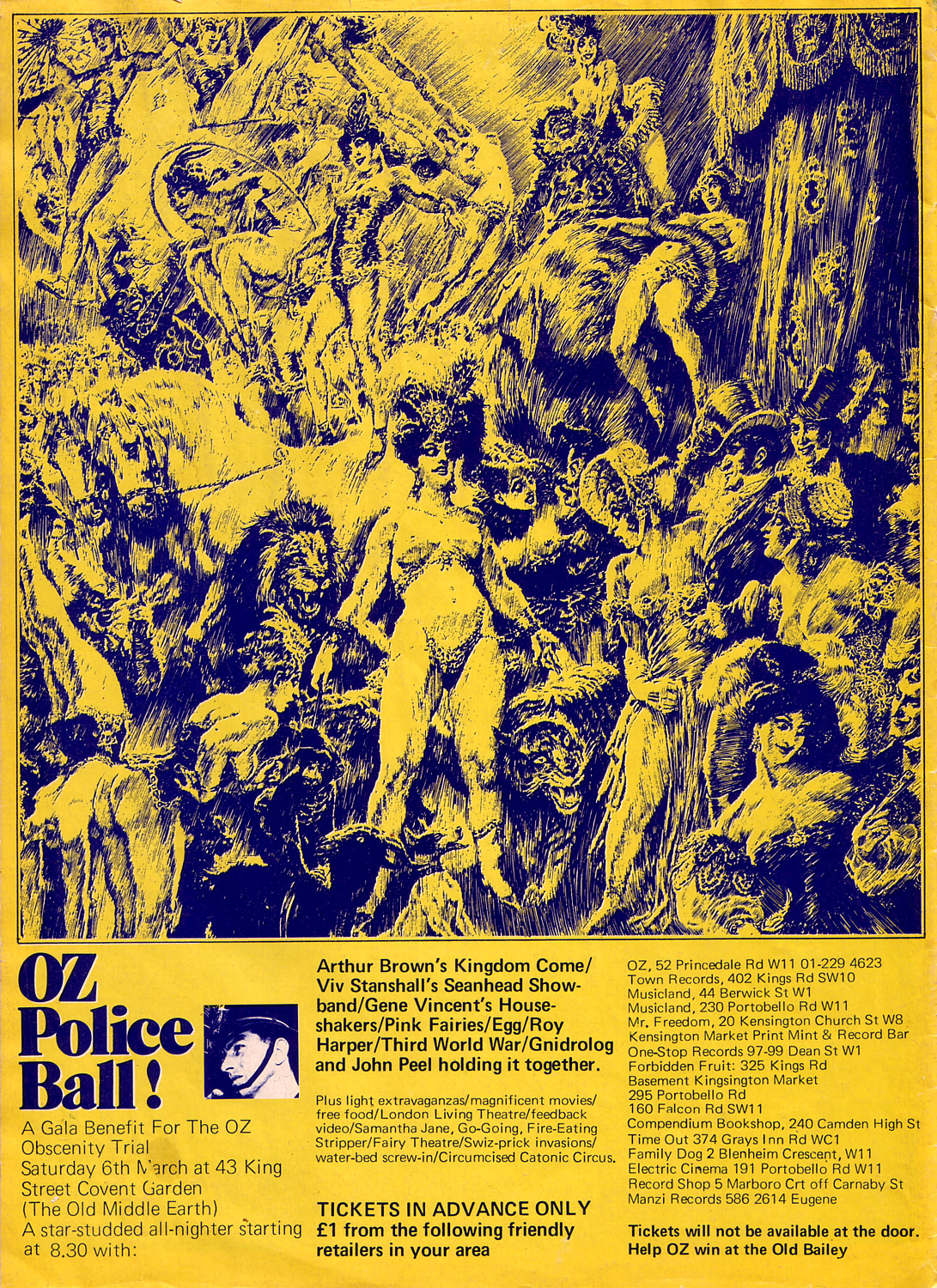
Oz London, No.33, back cover advertising "A Gala Benefit for the Oz Obscenity Trial"
The appeal in the Oz case was heard over three days in November 1971 with the Lord Chief Justice (LCJ), Lord Widgery, chairing a bench of three judges. Going by the written judgment the hearing was as sedate as the trial had been sensational. See part one here.
At the start of his judgment the LCJ emphasised that it was not for the appeal court to consider whether the jury was right or wrong, or to consider whether the publication was obscene or not obscene – that was a matter for the jury only. In the spirit of Mark Anthony the LCJ declared: “We in this court are not here to clear Oz or to condemn Oz.”
His lordship pointed out that the magazine contained a number of perfectly serious articles, a great many of which were “wholly innocuous”. The subjects covered included “school affairs, the system of education in this country, the system of corporal punishment in schools and a whole host of topics of that sort”.
But try as he might, the LCJ could not restrain himself from passing judgment on some of the content. Describing the back cover he said that “it shows some five nude women. It is extremely attractively drawn, and at first inspection, as one of the witnesses said, it appears to be a simple piece of artistic work. Closer inspection, however, shows that these women are lesbians or at least are indulging in lesbian activities.” He added that “attention has not unnaturally been drawn to that as an example of material in this magazine which might deprave or corrupt”.
Next, he mentioned the classified advertisement page referring to items in which “various people advertise for co-operation in sexual activities of a somewhat devious kind. For example, one advertisement is headed: ‘Voyeurs … Homosexuals. Lesbians, Heterosexuals, All Erotic Minorities’ …. and so it goes on.” His lordship concluded that these adverts “on one view certainly could be regarded as tending to corrupt or deprave as tending to induce and propagate these kinds of activity”. Even by the standards of his time the LCJ’s derogatory observations centred on sexual orientation were discriminatory. By modern standards they are bigoted.
Misdirection
The appeal hearing focussed on the three main charges under the Obscene Publications Act 1959. John Mortimer QC argued that the trial judge had given two serious misdirections on points of law. The first turned on the self-contained statutory definition of obscenity in that Act, the essence of which was a requirement that the effect of the item would “tend to deprave and corrupt persons who are likely, having regard to all relevant circumstances, to read, see or hear the matter contained or embodied in it”. This was a more stringent definition (had “a more limited meaning” according to the LCJ) than the one which applied to both the common law charge of conspiracy to corrupt public morals (of which the accused were acquitted) and the charge under the Post Office Act 1953 where the definition of “obscene” had its ordinary or “dictionary” meaning and included things which are shocking, lewd, loathsome, filthy and indecent.
The court accepted that, in his directions to the jury, the trial judge failed to distinguish the two separate definitions. As a result there was a grave danger that the jury wrongly applied the common law version to all five charges including the three under the 1959 Act.
The second misdirection concerned the defence of “aversion”. The defence had run a high risk line at the trial (thereby undermining their primary position that the magazine was not obscene) “that many of the illustrations in Oz were so grossly lewd and unpleasant that they would shock in the first instance and then would tend to repel rather than deprave or corrupt”. The court held that the trial judge had failed to give the jury adequate direction on this issue. This error of omission was compounded by misdirections about the factual content of expert evidence for the defence on aversion, the effect of which was “to destroy its value rather than to explain its value”.
The appeal court also held that expert evidence on whether the material in the magazine was obscene (evidence which had taken up many days of the trial) was inadmissible.
The outcome
The court concluded that these misdirections were so serious that the convictions on the three charges under the 1959 Act (publishing and possessing obscene materials for gain) were unsafe and must be quashed. The conviction on the lesser postal charge was upheld in the absence of any suggestion of a material misdirection. The six month prison sentences on that charge were automatically suspended.
In the course of the hearing, John Mortimer argued that prison sentences for convictions under the 1959 Act were very unusual and hence were unwarranted in this case. This was not a live issue given that the convictions were quashed, however, in the written judgment the LCJ, perhaps in the hope of stemming the tide of permissiveness sweeping the UK at the time, rejected this argument saying “when a particular offence becomes prevalent, and a wave of it appears, the only course which can be taken is to increase the sentences in order to adjust for the increase in the incidence of the offence … We would therefore like to make it quite clear in general terms that any idea that an offence under the Obscene Publications Act does not merit a prison sentence should be eradicated.”
A postscript
The LCJ described one item in the magazine in the following terms: “There is a comic strip in the middle of this edition … which shows a number of children dressed in school clothes indulging in a number of sexual activities including at the end a very crude drawing of a girl in the act of oral sexual intercourse. Shocking, undoubtedly; whether it was obscene of course was, as I have endeavoured to explain, a matter for the jury.” This item was not singled out by the court as being one which was particularly offensive or one which, on any view, might be regarded as obscene. The edition also contained a deeply offensive full page photograph of a young girl dressed in school uniform with a prominent headline reading “Jail Bait of the Month”. This item is not mentioned in the judgment at all. These omissions are in stark contrast to the LCJ’s derogatory comments about homosexuality which was a lawful activity by 1971. They suggest that the sexual exploitation and abuse of children were less rigorously condemned at that time than they ought to have been.
Judge Argyle was sore about the outcome of the appeal. In 1995, after his retirement (which was forced upon him for making public pronouncements against immigrants and in favour of the death penalty), he wrote an article in The Spectator in which he alleged that the Oz defendants had in fact been selling drugs to schoolchildren. Felix Dennis, by then a wealthy publisher, sued The Spectator and received damages of £10,000. He declined to sue the judge saying: ”I don’t want to make him a martyr of the Right: there’s no glory to be had in suing an 80-year-old man and taking his house away from him.”

Share this article:

Subscribe to our newsletter to not miss articles like this one:
 SUBSCRIBE