

Written by:

Our Legal Heritage: To duel, or not to duel?
 Reading time: 8 minutes
Written by:
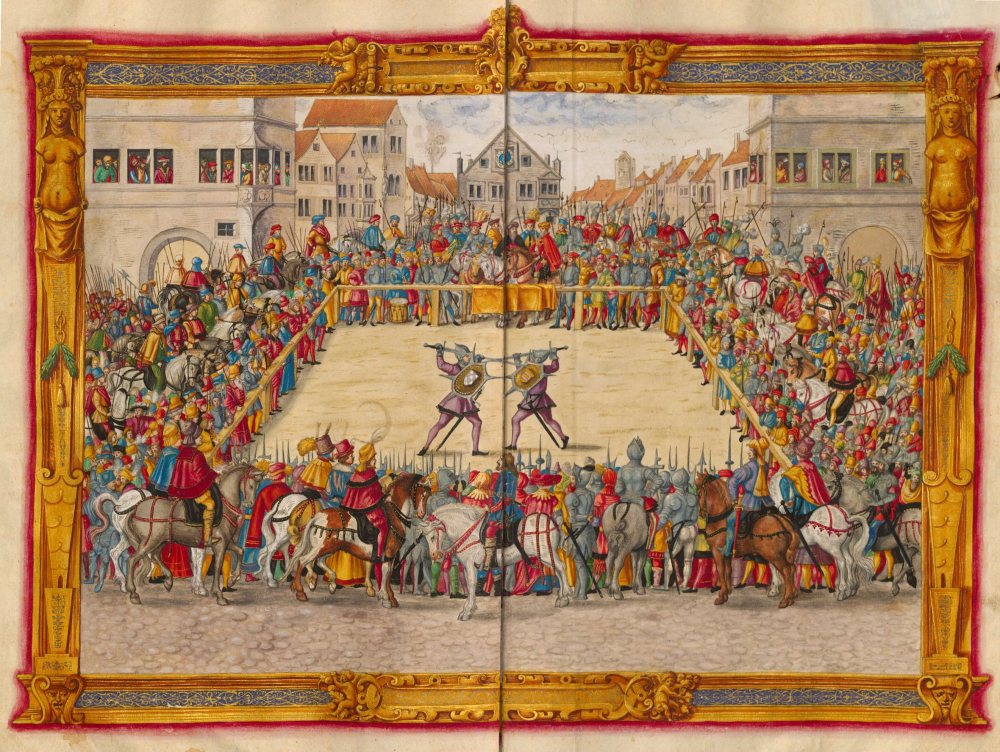
A 1540s depiction of a judicial combat in Augsburg in 1409, between Marshal Wilhelm von Dornsberg and Theodor Haschenacker. Dornsberg's sword broke early in the duel, but he proceeded to kill Haschenacker with his own sword.
In December 1984 an Edinburgh post office was robbed at gunpoint by two masked men.
Using a shotgun, they compelled the two terrified female staff to give them money before they escaped. Two brothers, John and Paul Burnside were subsequently charged with the robbery and firearms offences and in April 1985 they were brought to trial in the High Court in Edinburgh. One brother had been jailed in 1981 for being part of an armed robbery in another post office and both brothers had previously been jailed in June 1984 for housebreaking, theft and reset, and it appears that the robbery of the post office occurred almost immediately after their release from that sentence.
At the conclusion of their trial, Paul was found guilty of the charges, convicted and sentenced to 10 years’ imprisonment, while the case against John was found not proven. The sentencing judge, Lord McCluskey, stated that Paul “had acquired a formidable criminal record. He had been convicted on 13 occasions for crimes of dishonesty and he had also appeared at the High Court on assault and robbery and theft charges.”
So far, so normal (as far as the specifics of the crime go), and apart from Paul showing an impressive ability to escape from custody (which he managed both before his trial in 1985, and also in 1988 when on a work party from Saughton Prison) there’s nothing noteworthy about this case at all.
It’s not mentioned in the law reports or even the news sections of the main practitioner journals of the time. I’ve only been able to find one contemporary legal journal reference to the case, and actually, that’s really quite odd.
Because this case was incredibly procedurally unusual.
In fact, it’s the last time an accused requested that they undergo trial by combat rather than trial by jury.
Mr Robbie Burnett informed the court the week before the trial was due to commence that about 10 weeks previously he had been instructed by his client to request that they face trial by combat rather than trial by jury. Newspapers reported that the last time such a challenge had been issued was in 1603, although this is unconfirmed, and a date of 1597 is more likely.
This request for combat raised a number of interesting legal and procedural issues.
Trial by combat had been abolished in England by the Appeal of Murder etc. Act 1819, which had been introduced following the Ashford v Thornton case in 1818, where a family member attempted to use a challenge to battle to address a perceived miscarriage of justice. However this legislation does not specify its extent, and the 1972 case of McKendrick v Sinclair went to the House of Lords. In this case relating to compensation for a death which referenced an ancient law, Lord Reid was described by the newspapers as stating that “just because a law had fallen into disuse did not mean it was no longer part of Scots law. In appropriate cases, such a law could still be used.”
If this request for trial by combat had gone ahead, the lack of knowledge of the specifics of procedure presented another barrier. In England prior to 1819 the King’s/Queen’s Champion would have been expected to face the accused in a trial by combat. The Lord Lyon in Scotland and the College of Arms in London were consulted to identify who this person might now be, but the result was merely confirmation that Scotland has never had such a champion, “except maybe in the very dim and distant past.” In the absence of a champion, the belief was that the lord advocate would fill this role.
This would have meant that Lord Cameron of Lochbroom, the lord advocate, would have been required to step up to do battle. It seems that he would have had to don protective armour, grasp a leather shield, and prepare to face one of the brothers, both participants attacking the other with a wooden staff either “until one cried out “craven”, or the stars came out,” at which point the accused would be deemed to have vindicated themselves and would be regarded as innocent.
However, there was also a risk that wooden staffs would not actually be the weapon used. Professor Robert Black was asked about the potential combat procedure. He said “’there were very strict technical rules of procedure that had to be followed before a trial by combat should be staged. Unfortunately, most of these have been forgotten over the centuries since it was last used.” He also helped by jokingly explaining that the brothers probably hadn’t followed the proper process, which involved throwing down a white glove before issuing the challenge to battle, so there was still a possible way for Lord Cameron to dodge battle.
The day of the trial brought disappointment for any spectators looking forward to an exciting spectacle, as the expected motion for trial by combat was not lodged. Mr John Dowdall stated “It is with some regret that I inform the court there will be no motion for trial by combat.” He also said that “the court…would be denied the opportunity of seeing the advocate-depute squiring for the lord advocate in the lists in Parliament Square, Edinburgh.”
He claimed that research had been undertaken by both the defence team and the Crown Office and as a result the decision was that “the option of trial by combat was no longer open in Scotland.”
Mr John Dowdall, advocate for John Burnside, stated “it is with a considerable sense of anti-climax that I now wish to lodge a special defence of alibi which puts my client on a No. 14 bus between Pilrig Street and Boswell Parkway.” Meanwhile Mr Andrew Murphy lodged a plea of not guilty for Paul Burnside.
Paul had to take his chances with a jury, who decided that he had indeed been involved in the robbery. There was enough doubt about John’s involvement that the verdict for the charges against him were found not proven.
However, was this request for trial by combat truly invalid?
Two eminent legal academics, Professors David M. Walker and Hector MacQueen, both expressed a view at the time that despite the research done by the defence and the Crown Office, the request for trial by combat was in fact potentially a technically valid one.
Professor Walker was asked for his view of the validity of the request before the trial began. He stated that “as far as I can tell, it is a common law right which has never been abolished – and can never be, except by statute. The Crown can probably argue that there is now an extensive code of well-defined criminal procedure which supersedes the right, but we cannot prejudge the issue.”
Professor MacQueen in his deeply-researched 1986 article for the Journal of Legal History gave a detailed history of “modern Scottish cases on unused or outmoded law” which had been heard in recent years, and in reference to the 1972 McKendrick v Sinclair case he stated that it demonstrated the “general reluctance of the Scottish courts to hold that disuse deprives a remedy of legal force.” He showed that the transferability of the Appeal of Murder etc. Act 1819 to the Scottish legal context was doubtful, although the repeal of that Act by the 1893 Statute Law Revision Act may have had the unnoticed side effect of wiping out the right in Scotland. Other procedural issues such as the lack of a royal license and the existence of other remedies would mean that it would be technically difficult to successfully request trial by combat, but as he points out, the only way to truly remove the potential for accused to opt for trial by combat would be to legislate it out of existence.
Since statutory removal doesn’t seem to have happened since Professor MacQueen’s proposal, is trial by combat in Scotland truly dead?
Or is it in a zombie state, waiting for some brave legal professional to ask the courts to either reanimate it, or put it out of its long half-life?
Only one way to find out…
Jennifer Findlay is head of library and archives at the Scottish Courts and Tribunals Service

Share this article:

Subscribe to our newsletter to not miss articles like this one:
 SUBSCRIBE