
Our Legal Heritage: Edinburgh’s Parliament Hall
 Reading time: 6 minutes
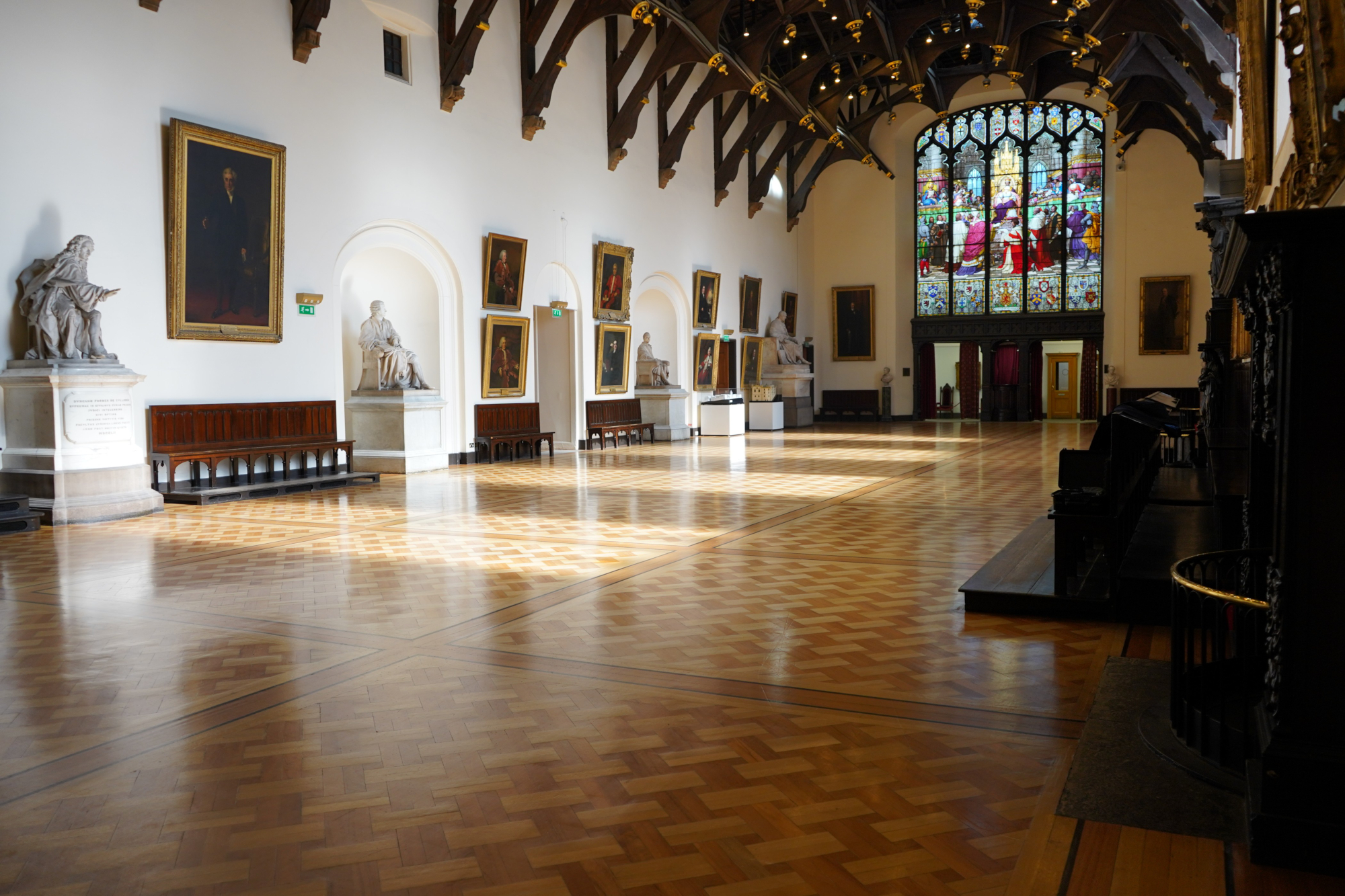
Parliament Hall
Credit: James Campbell
James Campbell looks at the history of our venerable Parliament House. He is also keen to hear from readers as part of his research, as detailed below.
Edinburgh’s High Street, or the Royal Mile as it increasingly came to be known during the 20th century, is a thoroughfare festooned with sites of historical significance. Said to measure the full ‘Scots mile’ – a now defunct unit of measurement noticeably longer than the ‘English mile’ – it runs downhill from the Castle in the west to Holyrood in the east.
Just off the Mile, tucked inconspicuously behind St Giles’ Cathedral, one can find a structure less famed than its neighbours but of similar, or even greater, importance historically, architecturally, and constitutionally: the Parliament House. Now more a complex than a singular house, this mass of buildings, extensions, and connections has grown almost organically over the centuries. Of course, this is far from unique in Edinburgh’s Old Town. Its gothic architecture has long appeared fantastical, its hilly terrain near impossible, but together form what Stevenson evocatively described as “this profusion of eccentricities, this dream in masonry and living rock”.
When completed in 1639, Parliament House was born into a chaotic and cramped Renaissance Edinburgh. Towering tenements on the Mile and the Cowgate, known as ‘lands’, reached as tall as 15-stories in height. “Inhabited to the very top”, Defoe concluded that “though many cities have more people in them… in no city in the world so many live in so little room as at Edinburgh”.
The Parliament House
Whilst today we think of Parliament House as an exclusively legal place, home to the Supreme Courts of Scotland, the building was originally mixed-use with its political function being paramount. Charles I had instructed Edinburgh’s Town Council to construct “a more commodious building” which would be ‘“for the ease and conveniencie of the estaits and the credite of the Kingdome”’. And in June 1632, according to the Council Register, it was decided it should be “buildit in that plaice quhair the ministers houses doe now stand”.
Unique in the British Isles at the time, and rare internationally, this was a purpose-built parliamentary building. As such it remains an important example of a novel civic architecture, one to accommodate an increasingly recognisable constitutional arrangement. For Edinburgh, this Carolinian programme of architectural development ushered in a new age for the Old Town. With Parliament House, generations of itinerance and irregular convening ended, and the Scottish Parliament had a permanent home. So too the College of Justice, long dissatisfied with conditions in the Tolbooths and other temporary accommodation, sat as the Inner House in a dedicated space in the jamb of the House.
Parliament Hall
Much as it was in 1639, and despite the growth of the complex, the great Parliament Hall remains the heart of Parliament House today. The history of this place is deep and intricate. Looking back from the present, across nearly four centuries, we could think of the Hall as having lived many different lives: as a parliament, as a series of courts, as a contested space populated with shops, judges, lawyers, litigants, and curious locals.
It is easy to forget just how much has transpired here. Charles I sat at the south-end of the Hall whilst Scotland was an independent nation, albeit one with a shared Crown by that time. Cromwell and his Commissioners for Administering Justice sat in the Hall whilst prisoners languished below. The Treaty of Union was ratified here in 1707 and, with its political function extinguished, the Hall thereafter became a primarily legal space.
In the years following, countless opinions would be issued by the Outer House judges who sat – three concurrently at times – against the Hall’s east wall. More informally, innumerable cases would be settled, negotiations conducted, and settlements reached here. It is staggering to think of how many meetings and quiet chats were had walking up and down the Hall. Indeed, every leading lawyer and judge in Scotland was here at some point, and a selection remain still, immortalised in the Hall’s portraits and sculptures.
Defoe, Boswell, Stevenson, and Scott were here, and so too various monarchs, politicians, and dignitaries made appearances over the years. The Hall has withstood political, religious, and social strife, survived plagues, great fires, and invasions, and persisted through revolution, Enlightenment, and industrialisation. It was here before there was a New Town, and it oversaw Edinburgh’s transition from Renaissance citadel to a world-renowned 21st century city.
Invitation to participate
Parliament Hall today serves as a salle des pas perdus to the Scottish Supreme Courts, as it has for nearly 200 years. It is a place for waiting, walking, meeting, thinking, looking, negotiating, and strategizing in the doorway to the courts. The Hall has been, and is still, many different things to different people. The experience of a litigant nervously waiting there is incomparable to the experience of their counsel who views it as a workplace, moving through it like their home away from home. So too the impression the Hall makes on people – the actual feeling of being there – varies by past experience, present familiarity, and perhaps above all, why one is there.
Having spent considerable time here, seated on a pew and walking the Hall, I have found myself thinking about these distinct experiences. It is one place, but one utilised so differently. This is what my own research looks to explore. As part of this I have been speaking with advocates, solicitor advocates, solicitors, and others both in the Hall and online. Although I am keen to speak with anyone with an interest in the Hall, I would be particularly eager to incorporate the perspectives of those currently underrepresented in my research: solicitors, female practitioners, and younger respondents: james.campbell@law.ox.ac.uk.
James Campbell is a DPhil candidate at the Centre for Socio-Legal Studies, University of Oxford. He holds law degrees from the University of Strathclyde, the University of Edinburgh, and the International Institute for the Sociology of Law in Oñati. He teaches at The Open University and is a visiting fellow at the Law and the Humanities Hub at the Institute of Advanced Legal Studies in London.

Share this article:

Subscribe to our newsletter to not miss articles like this one:
 SUBSCRIBE