

Written by:

OLH: Histories of private environmental law: part I - Air
 Reading time: 6 minutes
Written by:
Lord Advocate v North British Railway Co (1894) 2 SLT 71
The soundly educational 21st-Century Bar Conference last December 5th heard Lord President Pentland forecast that “litigation about environmental issues will become a greater feature of our forum”.
That may well been seen in a growth of the public-law proceedings, invoking statutory procedures and remedies, which are often categorised as ‘Environmental Law’. At the same time the importance of private law for the protection of the environment has equally to be borne in mind. Environmental law tends to be badged as a modern invention, but that has any truth only in public law.
Private environmental law has deep roots in Scotland. What the Lord President has forecast may show those roots continuing to bear fruit. The nineteenth century’s development of new industries in peaceful lowland landscapes created conflicts which are illustrated by four salutary cases. This is the first of a quartet of weekly recollections of them. Three illustrate the efficacy of the private law of nuisance; the fourth how purely heritable rights can effectively fence against the degradation of our landscapes. Each of the quartet concerned one of Empedocles’ four elements: Air, Earth, Water and Fire. We start today with Air.
Public law is often enforced by authorities with the advantage of public funds, while the ancient and abiding merit of private law is that it can be invoked without need of bestirring languorous public servants into action. The blessing of the common law, that it is sword and shield for free and fighting spirit of the individual, can serve Scotland’s nature, ecology and amenity. These features overlap where public authorities enforce their own rights in private law. Today’s example is Lord Advocate v North British Railway; ‘the Glencorse Station case’, where private law was turned to advantage by force of public authority.
Civilisation needs bulwarks against two foes, one usually distant, the other all too close at hand: hostile aggressors and human effluvium. First duties of the state are therefore defence of the realm, and disposal of sewage. In the air of Glencorse Station in Midlothian these imperatives clashed.
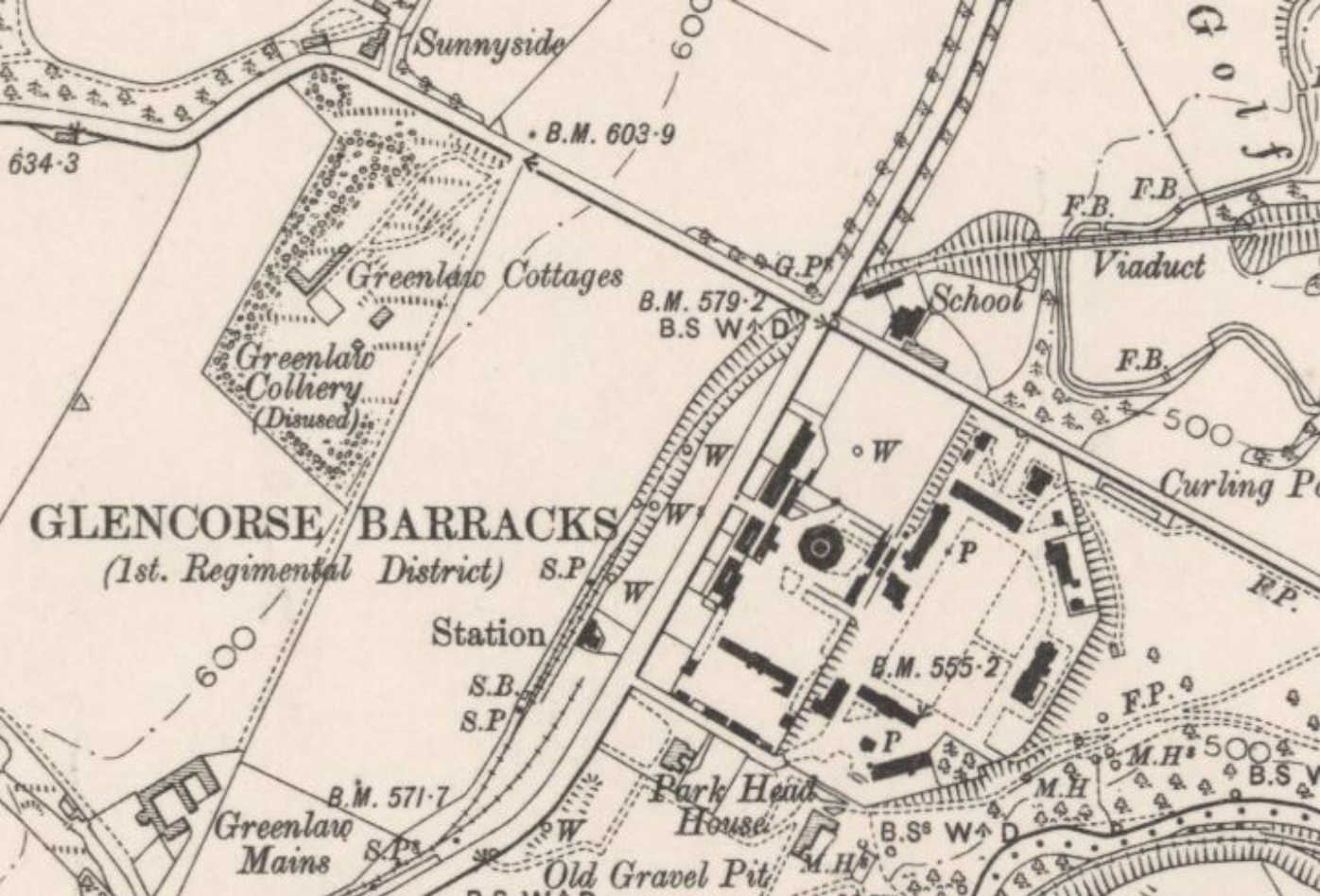
The military history of what is now Glencorse Barracks by Penicuik goes back to its origin as Greenlaw House of the Philp family. In the ’45, however warmly or shrewdly, they invited for tea the Jacobite ‘Duke of Atholl’ and his officers, who happened to be passing en route to invade England. By 1803 the Philps were gone, their home replaced by a jail for prisoners of the wars with Bonaparte, which became a military prison, and then from 1875 the barracks of the Royal Scots.
Two years later tiny Glencorse Station was opened. It stood directly opposite the barrack gates on the new Edinburgh, Loanhead and Roslin line, lately encompassed by Parliament into the undertaking of the North British Railway Co., all built integrally with the adjacent and rather fine new Primary School (still standing as you read). The passengers passing through the halt ranged from the meanest private soldier to prime ministers: in 1879 Gladstone alighted there during his Midlothian Campaign, as the guest of Cowan the paper-maker, of whom more later in the third of this quartet.
Three-quarters of a mile away in the 1820s, the agricultural revolution which transformed the physical landscapes of lowland Scotland between the mid-eighteenth and mid-nineteenth century saw the Trotters of Bush establish New Milton Farm. By the 1890s it was let to Peter Gow and his son Henry.
Farming on a thin substrate over glacial till at six hundred feet above the Forth has always required a lot of additional fertiliser. What better source than the quarter of a million people, plus horses, at Edinburgh ten miles to the north, now helpfully connected to Glencorse by rail?
Nowadays three million and more tons of “biosolids” leave British sewage works yearly to be spread on farmland, after processes intended to render them less noxious than were available in the 1890s. Back then, Edinburgh’s magistrates needed to ship out quantities of fairly raw “manure”. Where better than to men like the Gows, who could not get enough of the stuff?
And so a trade was born. The North British Railway were the middleman. Two thousand men of the Royal Scots, plus dependents, not to mention the locals of Glencorse parish, were now sharing the small railway halt with wagon-loads of Edinburgh’s effluvium. Worse still, the inhabited barracks themselves were separated from the station by little more than the width of Thomas Telford’s new Edinburgh to Peebles road (our A701). If Bonaparte was right that “Une armée marche au pas sur cet estomac”, the Royal Scots’ stomachs were turning: “human kind / Cannot bear very much reality”.
The stink had to stop. By 1894 word had passed up the chain of command. Rosebery’s Lord Advocate, John Balfour, MP, (later Lord President Kinross) was not languorous, and took up the cudgels for an interdict for the Army. From the bar he picked Robert Louis Stevenson’s friend Charles Guthrie to take the case. On his left John Comrie Thomson lead for the defence. In their youth at Edinburgh Academy, Balfour and Thomson had come first and second at the top of their final year; so it was to prove again.
Another friend of Stevenson’s, Lord Kyllachy, heard the proof in June that year. On the facts, nuisance was proved. On the law, the Lord Ordinary dismissed as irrelevant the railway’s defence that the nauseating quality of the goods was strictly the responsibility of the consignee, Mr Gow. The only saving that Comrie Thomson could achieve was fourteen days’ grace to come up with mitigations before interdict would pass.
The Glencorse air has smelt sweeter ever since.
When we were kids in Glencorse, the Philps were long forgotten. And thanks to Lord Kyllachy, New Milton assailed the nose no more than any other farm. In fact it was actually its neighbour to the south, Philpsburgh Mains by the station, that was locally known as “Smelly Farm”, lying on “Smelly Farm Lane”. When we bunked off from the school over the wall and across the axed railway line, it too had an unmistakeable smell; not sewage this time, but then still the lost, lingering odour of a real railway track. Just last year, the oldest farmer in the parish died, and with him the remaining memories of Glencorse Station as anything but willow-herb. Naturam expellas furca, tamen usque recurret. But remedies in private law can also help.

Share this article:

Subscribe to our newsletter to not miss articles like this one:
 SUBSCRIBE