


Written by:

Kapil Summan
Editor
Exclusive: AI cheating cases on the rise among Scots law students
 Reading time: 4 minutes
Written by:
Kapil Summan
Editor
The number of law students suspected of using AI to cheat has risen at several Scottish universities, an investigation by Scottish Legal News has found – with one expert warning that the figures are likely underreported.
SLN made freedom of information requests of all Scottish universities that offer the LLB, revealing dozens of confirmed cases of AI misuse. While every institution replied, Dundee University failed to satisfy the request until a review was sought. The university aggregates misconduct cases by school and claimed it therefore lacks data on specific programmes students are enrolled on.
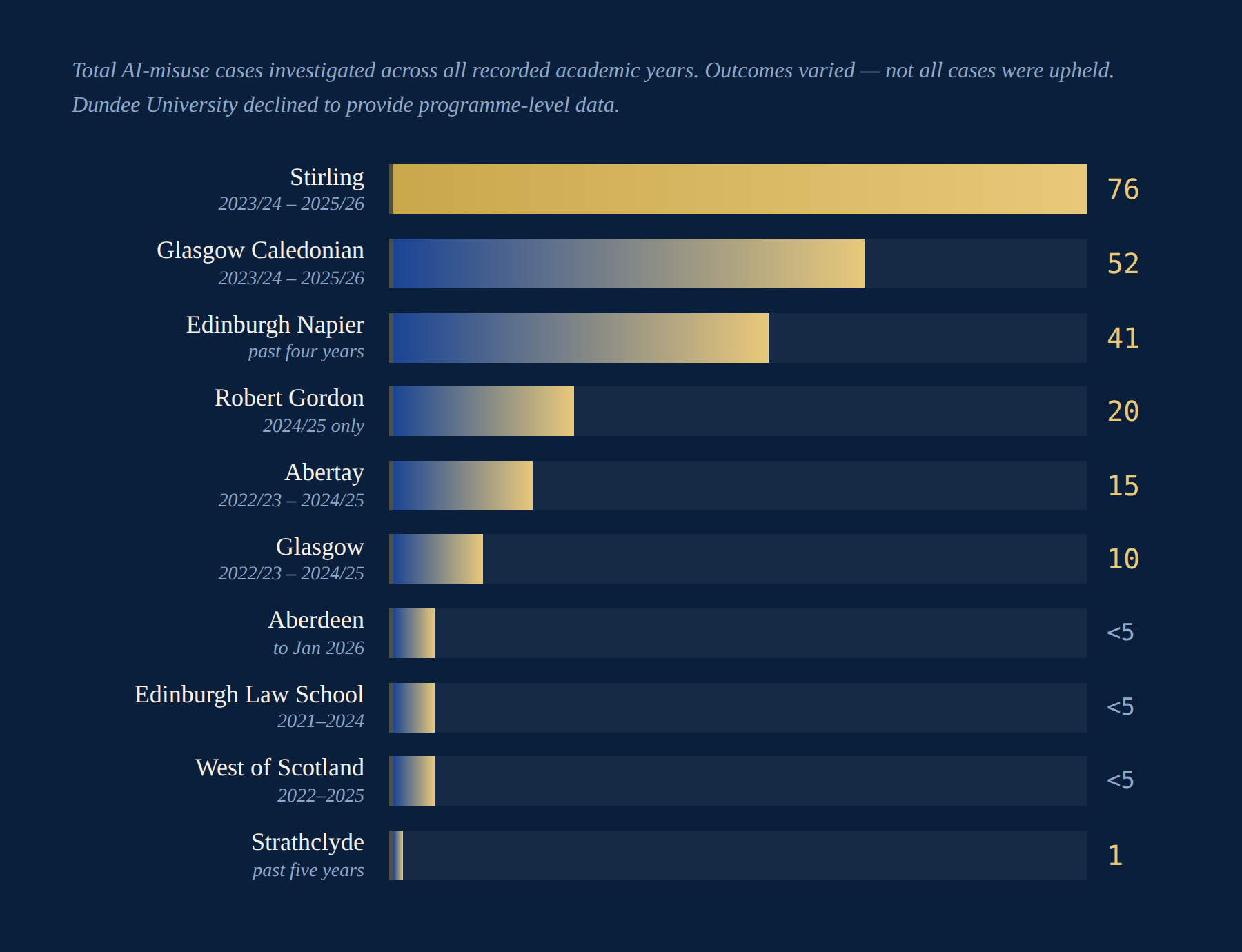
At Aberdeen University, between 2022 and 6 January there were fewer than five cases of law students investigated for cheating with the aid of AI. The exact number is not included to safeguard the identities of individuals. All cases brought against students were proven.
Abertay University recorded one case of unacceptable use of AI in 2022/23 by a law student. This rose to seven in 2023/24; the same number was recorded in 2024/25.
Glasgow Caledonian University began recording improper use of AI by students in 2023/24. That year there were eight cases concerning law students, all of which were upheld. In 2024/25 there were 29 – of these 17 were upheld, six were “determined to be poor academic practice” and six were not upheld. From 2025 to date there have been 15 cases, all of which have been upheld.
Glasgow University, which began recording misuse of AI cases in 2022/23, said in its response that there had been 10 such cases with respect to law students between that date and 2024/25. In all cases students received penalties.
There have been 41 cases of suspected AI misuse by law students recorded at Edinburgh Napier University in the past four years.
At Edinburgh Law School there were fewer than five cases involving misuse of AI from 2021 to 2024. As with Aberdeen, the exact number is not included to protect the identities of individuals.
At Robert Gordon University, which only began recording AI misuse in 2024/25, there were 20 established cases of “false authorship” by law students.
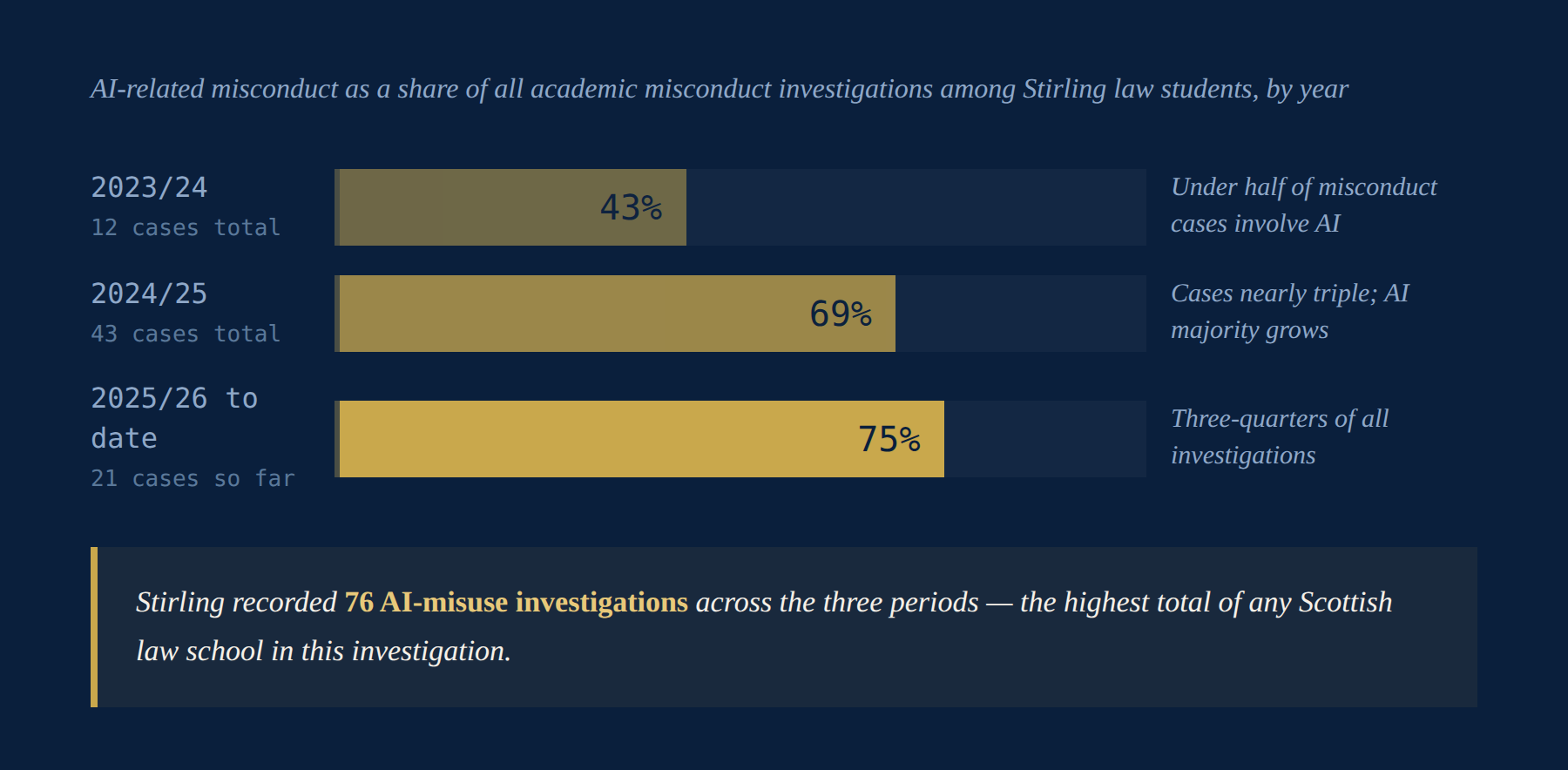
Stirling University recorded 12 cases of “inappropriate use of AI tools” by law students in 2023/24, 43 in 2024/25 and in 2025/26 (to date) 21 cases. AI misuse went from 43 per cent of the cheating investigations in 2023/24 to 69 per cent in 2024/25 – and 75 per cent of cases to date.
In its response to our FOI, Strathclyde University said that – in the entirety of the past five years – there had only been one case of a law student investigated for cheating.
The University of the West of Scotland recorded fewer than five academic misconduct cases regarding law students in each academic year between 2022 and 2025. One case in 2024/25 used ChatGPT.
Speaking to SLN, Dr Thomas Lancaster, a principal teaching fellow at Imperial College London, whose research interests include educational use of generative AI, academic integrity, and student cheating, said there is “a lot of debate within universities about the best way to teach and assess the use of AI” and that it is “not something that universities can ignore”.
He added: “One of the biggest challenges I observe is how to differentiate between the assessments that allow AI, and those that don’t, and also the different views that both lecturers and students have.
“A challenge is that, if students use AI well, as a basis for ideas, or with heavy rewriting, it’s near impossible to identify that it has been used. The same is true if a student hires a human writer to complete their work for them. But like any form of academic misconduct, the reported numbers are always going to be much lower than the real numbers. Not everyone gets caught, and even when they do, there are levels of severity so not everything will go through a formal process.
“The danger is that AI simply gives the wrong information, or it cites law which is relevant in other parts of the world. That’s also one of the main ways in which the misuse of AI can be detected.”
He concluded: “There might also be law lecturers who are less willing to progress a misuse of AI investigation in law than in other subjects because the consequences to the student are greater – and might result in disqualifying them from future employment prospects in the field. Students do still need space to make mistakes and learn from them.”
David Meighan, head of education at the Law Society of Scotland, told SLN: “Students should be aware that improper use of AI may have negative repercussions that extend for a considerable period of time. For example, we would consider the circumstances around proven academic misconduct in deciding whether to accept an application for an entrance certificate to become a Scottish solicitor.”

Share this article:

Subscribe to our newsletter to not miss articles like this one:
 SUBSCRIBE