

Written by:

Review: When Highland voters humiliated Randolph Churchill
 Reading time: 3 minutes
Written by:
How do acute political tensions, resolved in national politics, influence local conditions? The deciding factors in decisions at each level may vary even for those who think the same.
The Stalinist view was simple: ‘all decisions are taken at the centre, and once a decision has been taken all discussion on the matter cease’. Not everything is as simple as that proposition.
These sorts of ideas arose in practice when former Prime Minister Ramsay MacDonald and his son Malcolm lost their parliamentary seats in the 1935 General Election.
A National Government had been formed and the Prime Minister Stanley Baldwin wanted both men returned to Parliament quickly to present an administration across all parties.
The seat of Ross and Cromarty became vacant in January 1936 with a resignation for medical reasons. Malcolm MacDonald was to be the National Government candidate.
What might have been expected to be a formality became a bitter and extraordinary by-election, partly because expediency at the national level required cynical voting locally.
Malcolm MacDonald was a former Labour Party MP and the local Liberal Party members invited him to stand as National Government candidate, and he accepted.
Separately, the Unionist Association objected politically, because MacDonald and his son were socialists and being forced on them, and they asserted their independence of Central Office.
In deciding to field independent candidates, the Unionists’ choice of candidate, Randolph Churchill, son of Winston Churchill, proved highly divisive.
As demonstrated by this excellent example of microhistory (the sustained analysis of a narrow theme) the procedure adopted for the appointments of candidates was bitter and divisive.
The campaign was dominated by the sons of two British Prime Ministers, candidates who loathed one another and did not hide it: their respective supporters were hardly best friends.
Macdonald would go on to triumph and humiliate Churchill. He won with 8,949 votes while Churchill trailed in with 2,427 – third behind the charismatic socialist Hector McNeil who took 5,967.
Into this mix various actual or potential independent candidates emerged from groups who maintained the right to select their candidate in preference to directed candidates.
What could possibly go wrong? It did not help that Mr Baldwin, the Conservative and Unionist Prime Minister, endorsed MacDonald, the Labour Party member, for election.
Practical considerations such as the geographically vast constituency, very bad weather including heavy snow, rampaging deer, motor vehicle crashes and a large fire in a bakery in Dingwall served to complicate matters.
The whole event took place in the presence in large numbers of journalists, and many were up from London; and the death of King George V all added to the uniqueness of the event.
Rob McInroy has done an excellent job in explaining what the nature and extent of the political turmoil, and the vituperative and personalised nature of the canvassing.
By-elections are often, in conventional political history, relegated to a sentence. This compelling study shows the many complex issues, national and local, on the way to the result.
The book does not have conventional chapters: after a general Introduction the daily events basis reveal the true nature of practical politics on the stump, albeit under difficult conditions.
That approach displays the stamina required of all candidates in various types of remorseless conditions. The story ends with a summary of what happened next.
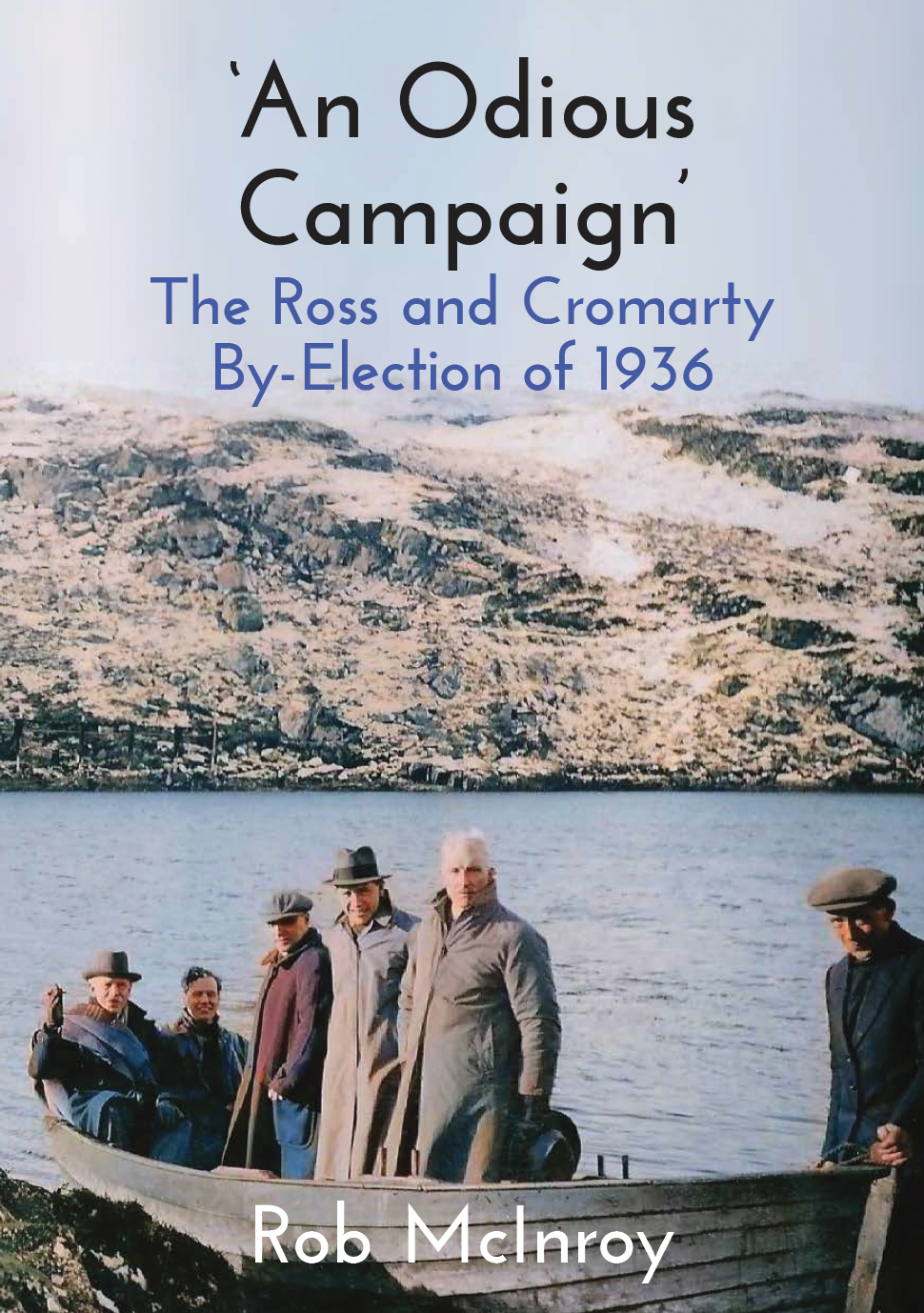
‘An Odious Campaign’: The Ross and Cromarty By-Election of 1936 by Rob McInroy. Published by Tippermuir Books, 276pp.

Share this article:

Subscribe to our newsletter to not miss articles like this one:
 SUBSCRIBE