

Written by:

Review: The ‘three deaths’ of Adolf Hitler
 Reading time: 4 minutes
Written by:
The death of Adolf Hitler is said to be unique in the history of modern dictators. His death occurred amid imminent regime change. The absence of a successor government meant an absence of an administration with the ability, or inclination, to perform full funeral rites. There was no national period of mourning, formal lying in state or official memorial service.
There was also no visible death scene, or any public display of the remains of the deceased, if only for proof of the death having occurred. Hitler had learned of Mussolini’s treatment; the latter had been shot and his body dumped in a street and then suspended upside down in a manner traditionally used to symbolise the ‘villainy’ of the deceased.
Hitler decided to take his own life (to avoid desecration of his remains) and to do so within the privacy of his wartime headquarters in Berlin. Suitable preparations were made and thereafter few individuals were able to enter the room and view the remains. Disposal of these involved the same few individuals whose activities were without photography or ritual.
The victorious Allies, and their citizens, sought conclusive proof of the death of Hitler, but with all the uncertainty it became possible for rumours of survival to grow, and counter-explanations to be suggested. As Dr Sharples notes, the literature on the death of Hitler has hitherto “stalled” between efforts to prove or refute his suicide.
The approach in this excellent addition to the literature is to adopt three unique strands for exploring the death of Hitler. First, it expands the conventional, chronological framework beyond the core investigative period of 1945-46. Secondly, it stretches the geographical parameters of the whole events of the death of Hitler.
Finally, an approach to the death by a consideration of the relevant cultural and emotional history enables an understanding of how information on the fate of Hitler was constructed, disseminated and received by different audiences; and to draw on a new set of diverse sources. German views are considered more strongly than ever before.
For the most part, the structure of the book is chronological to show how evidence of the fate of Hitler has been collated over time. A critical assessment of the evidence, the author argues, has permitted a better understanding of the event itself in context. Similarly, the work of other historians is, where necessary, challenged to show how alternative interpretations developed.
That chronological approach results in a large amount of literature on the evidence being made available. The death of Hitler came to be known internationally long before there was any details in the public domain as to how the terminal event occurred: cyanide or bullets? If the latter, in battle or otherwise?
Dr Sharples identified three ‘deaths’ of Hitler: political death in 1945; legal death in 1956 when the West German authorities finally registered his death; and medical death in 2018 when certain advances in that regard were considered significant.
Much of the later part of this study is taken up with a narrative of the decades of ideological wranglings and methodological weaknesses, many of the instances of each being between government agencies in the same country or otherwise at an international level. Not a few of the ‘revelations’ were basically for commercial gain, such was the continuing interest.
The circumstances of the death of Hitler, a fulcrum as explained convincingly in this well-researched study, has many meanings and consequences. Forensic pathology and odontology are well-covered, as is the investigative efforts of many government agencies. Principally, the death had seismic effects on domestic politics and the demoralised armed forces.
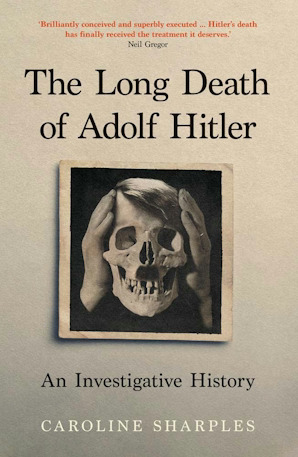
The Long Death of Adolf Hitler: An Investigative History by Caroline Sharples. Published by Yale University Press, 336pp, £25.

Share this article:

Subscribe to our newsletter to not miss articles like this one:
 SUBSCRIBE