


Written by:

Review: The brilliant career of Neil MacCormick
 Reading time: 3 minutes
Written by:
Machiavelli wrote something to the effect that people ‘dislike enterprises where the snags are evident’.
That throwaway line from the Master may be recalled when attempting to review this excellent and wide-ranging biography of Neil MacCormick personally or his intellectual achievements.
The difficulty with MacCormick is his wide range of academic interests, and an affability combined with a resolve to challenge what he perceived to be wrong politically (as did his father).
These are attributes different to MacCormick’s university achievements. His first in moral philosophy at Glasgow had, as a sort of later add-on, another first in philosophy at Oxford.
Maksymilian Del Mar, an unforgettable name by the way, a solicitor in the State of Queensland, is now professor of legal theory and legal humanities at the University of London and he has done Professor MacCormick proud with this thorough study.
Del Mar acknowledged the significance of the time that MacCormick spent in between his periods at Oxford. The lectureship held by MacCormick at Dundee for two years, 1965 to 1967, was his first academic appointment.
The time there allowed for wider reading and also, crucially, his being able to extend his contacts with the Scottish National Party locally, and to support his brother in his parliamentary attempts.
There was also a revolution then in the legal education at Dundee with the newer degrees featuring jurisprudence heavily as a star subject. Del Mar’s interesting narration of that time suggests a developing conventicle of modern jurists.
It is interesting to read of the practical reasoning of MacCormick which drew on training in moral philosophy at Glasgow with “further encouragement and impetus” from his teaching and colleagues in Dundee, especially Professor Ian Willock.
MacCormick made contributions to theories of legal and moral reasoning, institutional legal theory, nationalism, post-sovereignty, subsidiarity, and constitutional pluralism in Europe.
It may seem odd then that such a key mover in the theory and practice of Scottish nationalism, should be called to the Bar of England and Wales, and advance to the front rank, honorarily, of the legal profession there.
It is made clear by Del Mar that MacCormick’s initial readings in Scots law were with a view to becoming an advocate. However, that interest really had to be seen in the context of his wide interest in English and Roman law.
Del Mar did not need to try to make sense of some of the contradictions in the brilliant career of MacCormick, in theory and practice, and such an attempt is not made.
Contradictions? Perhaps few theoretical jurists are as imbued with practical politics, that move immediately with the times, than MacCormick who became a member of the European Parliament, and was engaged philosophically and politically.
Theoreticians, of law and political science, will find much in this book to consider that adds personal context to the academic and intellectual contributions to their work by MacCormick; and lawyers in practice may wonder at his energy.
MacCormick, it might be supposed, dealt with constituents and their problems as well as the jurisprudence of the European constitution, and whatever was best in the interests of Scotland, but the latter was never with any legal nationalist defensiveness.
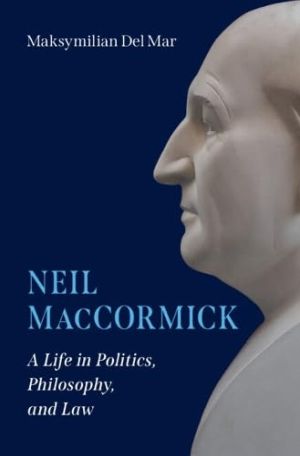
Neil MacCormick: A Life in Politics, Philosophy, and Law by Maksymilian Del Mar. Published by Cambridge University Press, 630pp, £29.99.

Share this article:

Subscribe to our newsletter to not miss articles like this one:
 SUBSCRIBE