


Written by:

Review: Rough justice
 Reading time: 5 minutes
Written by:
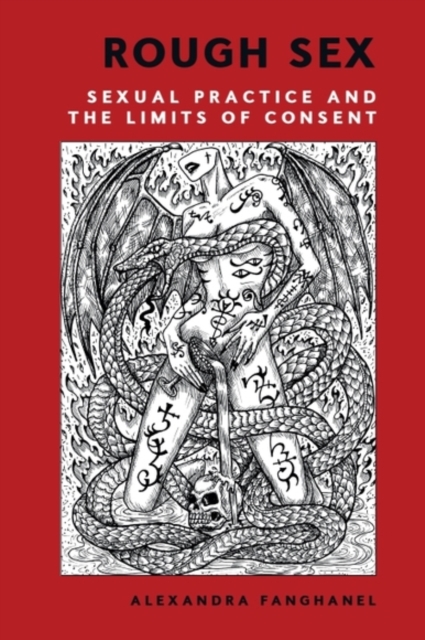
The overarching premise of this book is that one person’s kink is another person’s normal, and who are we to judge. Indeed. This is especially pertinent in a world where we are encouraged towards inclusivity – anyone and anything goes. Again, indeed. But when considering the licence society extends to the individual wishing to self-harm, to participate in rough sex, to enjoy subcultural ‘deviant’ sexual behaviours, when is the line crossed? When does rational behaviour become irrational? When does consenting to ‘choke me a bit’ become non-consensual asphyxiation? Being unconscious removes one’s capacity to consent, so in what circumstances can consent be a defence in law?
Alexandra Fanghanel’s analysis of her selected case studies of the defence of consent in rough sex prosecutions – she said I could asphyxiate her – is detailed, careful and insightful. Taking the reader into the world of bondage-sadomasochism (BDSM) to explore notions of consensual behaviour that, to some, might appear as abusive, is provocative and adventurous. Consent is no defence where injury has been inflicted that exceeds definition as “merely transient or trifling” because logically who would consent to that amount of pain? Yet, within BDSM practices, consent to potentially injurious behaviour is navigated and acceptable. ‘Consent, communication and voluntariness’ are BDSM’s ‘gold standard’ – safe words, prior agreement of degrees of pain all keep BDSM enjoyable and safe. But when a man appears in court claiming that his partner ‘wanted it’, then understanding how consent works within the BDSM community may be helpful in establishing consent within increasingly mainstream ‘rough’ sexual activities. Rightly, Fanghanel explains that “consent is thorny, slippery, contingent” and judicial and juridical participants would certainly learn from this in-depth examination of consent, how it is constructed and tested in court.
As Fanghanel indicates, there is a risk that the sexually violent man may attempt to disguise his toxic masculinity as consensual BDSM or BDSM-adjacent ‘fun’, using BDSM as an alibi. From her case studies, it is evident that this defence strategy has more success when the complainer appears in court than when she has been ‘consensually’ murdered, because alive, her lifestyle and sexual history can be employed to traduce her. Female sex workers, drug addicts, those suffering mental health issues or enjoying and initiating sex, all become attributes in court that can potentially create judicial and juridical bias. These biases are not sex positive or inclusive of all sexual behaviours and they emphasise enduring rape myths about sexually audacious women ‘asking for it’. As Fanghanel puts it, “consent is weaponised in the courtroom”. Her research reveals that where the consent defence is accepted, charges may be reduced from murder to manslaughter or even acquittal in cases with a surviving victim.
However, Fanghanel’s assertion that BDSM and rough sex are not the same thing – once more, indeed – deviates into an argument for greater education of judges and jurors in BDSM practice so that if a practitioner finds himself or herself in court, they will be judged on their own consensual ‘contract’. In exploring the possibilities arising from decriminalisation of BDSM, she acknowledges the potential for intimate partner violence to hide within BDSM, yet also the potential that destigmatisation will encourage reporting of abuse. This is good for the BDSM community, but what good does it do hetero-normative victims of sexual violence? As Fanghanel quotes from R v Welch (1995): “the personal interest of the individuals involved must yield to the more compelling societal interests which are challenged by such behaviour”. The law protects for the greater good. No one should be ostracised or criminalised for their sexual preferences, but the law is a level playing field and exceptionalising some sexual practices and not others, particularly when they appear ‘roughly’ very similar to the uninitiated, is potentially risky legal territory.
This book is an important, intriguing and provoking exploration of consent from a different perspective and should be essential reading for anyone intending to participate in Scotland’s new Sexual Offences Court. It offers lessons in the use of inclusive vocabulary and excising moralistic values from judges’ summings-up and instructions to the jury, arguably the hardest group to reach with societal and unconscious bias training. However, the book prompts two observations.
First, where are the middle-class victims and perpetrators of rough sex? They are not mentioned in this study, so are they visible in the court records? Or do the middle classes practise BDSM within ‘the rules’? Is their participation in rough sex always consensual and never criminally injurious? Second, the last chapter is particularly interesting to anyone who has encountered Michel Foucault’s arguments for desexualising rape charges. By removing the sexual element from rape and other current sexual offences, these crimes are placed somewhere on the sliding scale of assault to murder. By removing the sexual element, the requirement to establish consent also disappears, after all who, in their right mind, would consent to injurious assault? To the insertion of a fish-hook – albeit sterilised – into their penis, to use Fanghanel’s example. How does the court discover abusive coercion if consent is not discussed or established? Thus, in removing the ‘aggravating’ factors of sex and consent, would it really allow future prosecutions to focus on the usual circumstances of any abuse, assault or murder trial which is not gendered violence? What evidence might be missed by doing so?
Rough Sex: Sexual Practice and The Limits of Consent by Alexandra Fanghanel. Published by Edinburgh University Press, 168pp, £90.00.

Share this article:

Subscribe to our newsletter to not miss articles like this one:
 SUBSCRIBE