


Written by:

Review: Peter Rachman – the archetypal slum landlord
 Reading time: 4 minutes
Written by:
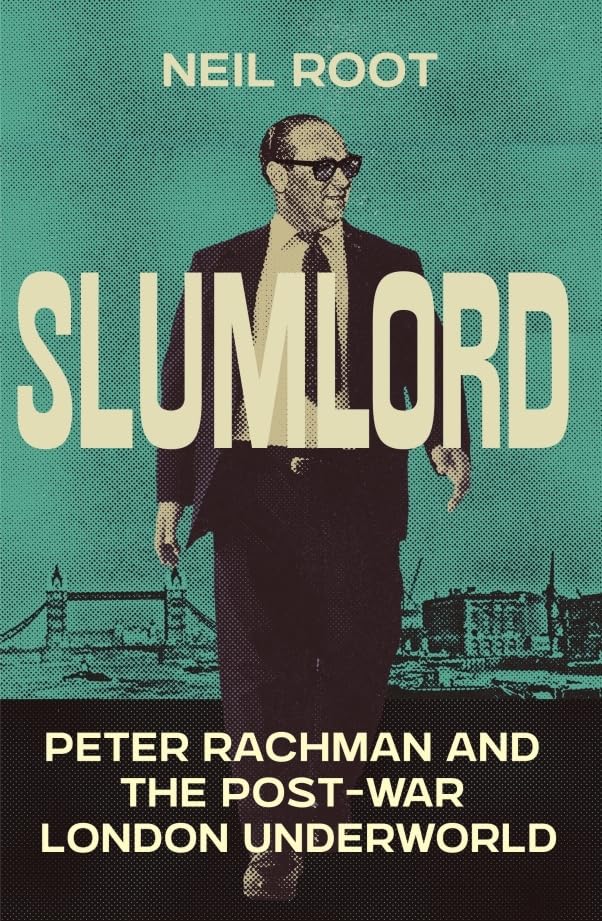
In this true, but often scarcely-believable, story Neil Root explains as best can be done the personal history of Peter Rachman before the latter arrived in Britain. His mysterious background relies for the most part on Rachman’s own undocumented explanations.
The utterly chaotic administrative turmoil during and after the Second World War in Poland, and other surrounding nations, meant that the ordinary records of events simply were destroyed in total war, or the purported events did not happen.
In Rachman’s case, little evidence exists of where he lived, or what happened to his parents but it seems ‘almost certain’ that they were both killed in the Holocaust, as he had said to acquaintances later in Britain. He purported to have a brother but he too disappeared.
The point of narrating that personal background is that Ron Hall, an investigative journalist of The Sunday Times who sought out Rachman’s business, had the maxim that “you can’t write a story if you don’t understand it”. Life did the younger Rachman no favours.
One surprising point that needs to be understood is that Rachman had his admirers. In an era when rented accommodation routinely had now objectionable signs such as ‘no blacks, no Irish and no dogs’, Rachman did not discriminate on racial grounds.
It now seems, according to several writers, that Rachman was “a minor player in a much bigger racket” in which he was not the prime mover, but he has been made “the face and name” of a type of business. It is clear then that Rachman’s business arrangements were not charitable.
It is incomprehensible now that Rachman could live and work in Britain for years freely while registered only as a stateless alien, his application for British nationality having been refused. He seldom completed a tax return, and he was said to be teetotal.
Rachman operated on the margins. Rent law assured tenancies, rent books and fixed rents, but the desirable arrangements (for wily opportunist landlords) were far more pragmatic, especially where rented property was needed to be sub-let for all sorts of business.
In particular, Rachman’s technique was to buy property occupied by statutory tenants paying controlled rent. With a mixture of intimidation and exploitation of racial tension, force the secure tenants out, and thus increase substantially the value of the property.
The property in the short term might then be over-crowded with immigrants, particularly from the West Indies, or let it at exorbitant rents for various businesses. The true beneficial owner of these properties was hidden by a mosaic of legal entities.
The story of all this is well told by Root and so too is the real change in financial arrangements, and persuasive violence, when the Kray Twins appear and make offers to purchase going concerns: Ronnie and Reggie had their own distinctive business model.
Moreover, Root does a good job of locating the Rachman operating arrangements in the morass of London social life of a certain kind that led on to the Profumo scandal. Indeed, it is surprising to see how many key players, some familiar names, were involved in these events.
Finally, the book does not have an index but it concludes with three appendices that list known properties of Rachman rented to general tenants, known companies, and the properties let for specific purposes and estimated to be operating from them in May 1959.
A fourth appendix indicates the huge number of Rent Tribunal cases, orchestrated by locally elected politicians, that brought Rachman to the attention of the press and the public. These businesses continued until Rachman died, in 1962 aged 42 years, of coronary thrombosis.
Slumlord: Peter Rachman and the Post-War London Underworld by Neil Root. Published by Icon, 228pp, £20.

Share this article:

Subscribe to our newsletter to not miss articles like this one:
 SUBSCRIBE