


Written by:

Review: ‘Justified homicide’ and the sad state of American society
 Reading time: 4 minutes
Written by:
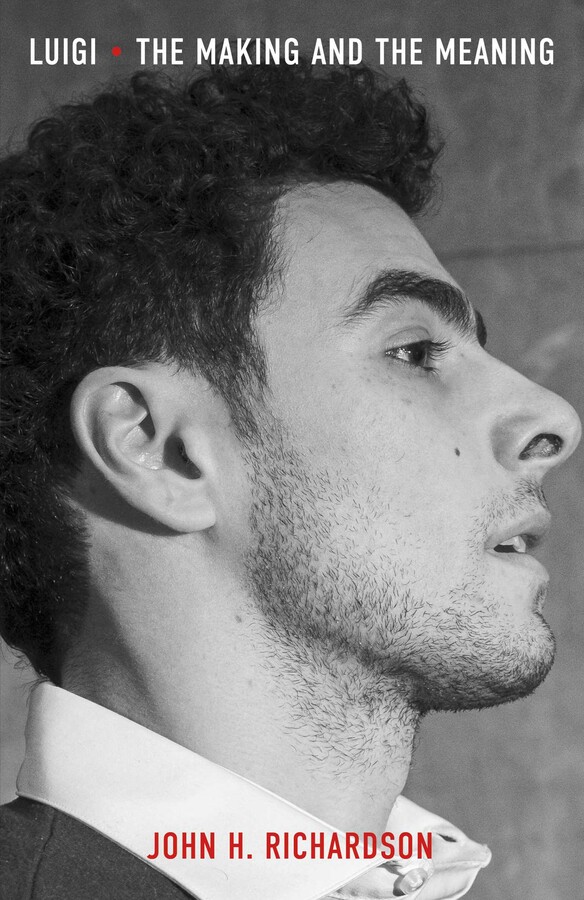
Reduced to its basics, in the style of an exam question, the issue in this small but important book is that A is charged with the death of B by shooting him, but a trial is yet to take place.
However, A is no fool and is steeped in the virtuous, or challenging, politics of his era and B is, on one explanation, thoroughly disliked by many, but not all. Discuss.
The author asserts in a prominent note that he very much believes that ‘Luigi’ is innocent until proved guilty, and speculation is conditioned “on that righteous legal scruple”.
The relevant politics are, on one side, those of a massive healthcare company and the overall profitability of the business, on which the exceedingly generous executive bonuses are based.
On the other side are the members of the public insured, or so they thought, with the same company to cover all their medical bills in the event of illness.
The key phrase implicit in much of these medical disputes seems to be “delay, deny and defend”; those few words encapsulate the alleged attitude of the medical health company.
Some matters are materially different in America from how lawyers in the United Kingdom and the Republic of Ireland would approach such a high-profile and deeply sensitive case.
The cautious lawyer might prefer to await the outcome of a case, which some in authority have already described as “an act of political violence”; and the death penalty is to be sought. They do things differently in America, and this book is a summary of the personal factors and national disputes that the author argues are helpful in the explanation of the killing.
The background politics of the whole event are infused with neo-Luddism and the views of many contemporary thinkers, of sorts, and not least Ted ‘Uncle Ted’ Kaczynski.
Uncle Ted, also known as the Unabomber, lived as a hermit for a long time and he is now serving a long sentence. He has been able to correspond with the author and many others.
His politically apocalyptic views remain very attractive to some, although overshadowed a bit by his bombing campaign leading to several deaths and many individuals being maimed. What is in issue is “not a right/left thing” but a general idea of the industrial revolution being a disaster for the human race, the few practical gains being offset by qualitative losses in life.
All criminal trials and civil litigation have their own dynamics from the advocacy and the contentious issues, but the trial of Luigi Mangione may be in a modern category of its own.
He already has many sympathisers: not least the alibis offered immediately on arrest. There has also been a substantial sum of money raised by public subscription for a defence attorney. The trial may concentrate, if relevancy is considered a very broad outlook, on the real nature of the profitable American healthcare provisions and the views, presumably, of the jury.
It is suggested by the author that the speculation, by journalists and attorneys with a passing interest, is that the defence will be one of ‘justified homicide’. That may be a tricky area. John Richardson has done a good job explaining, proof read closely by an attorney no doubt, the background of the accused, and the business practices of the healthcare company.
The bigger picture of the sad state of American society is further described by Richardson and he sets a scene for the causes and consequences of the thinking of Mangione.
That is achieved by an analysis of the array of publications and conversations online from Mangione as one who has come to live online and share generously his thoughts.
British readers might balk a little some of the ‘yeah, right!’ tendencies of the writing style and the apparently subjective references to ‘Luigi’ by the author, but this book is instructive.
A second edition may cover the trial, and a third edition the appeal, if they occur. On past American form, a fourth edition will follow the execution in 25 or so years’ time.
Alternatively, if the homicide of Brian Thompson is held to be justified, and Mangione walks free, much more might follow as the limits of justification are settled for future reference.
Luigi: The Making and the Meaning by John H. Richardson. Published by Simon and Schuster, 272pp, £20.

Share this article:

Subscribe to our newsletter to not miss articles like this one:
 SUBSCRIBE