

Written by:

Review: Guatemala’s forced adoptions and missing children
 Reading time: 4 minutes
Written by:
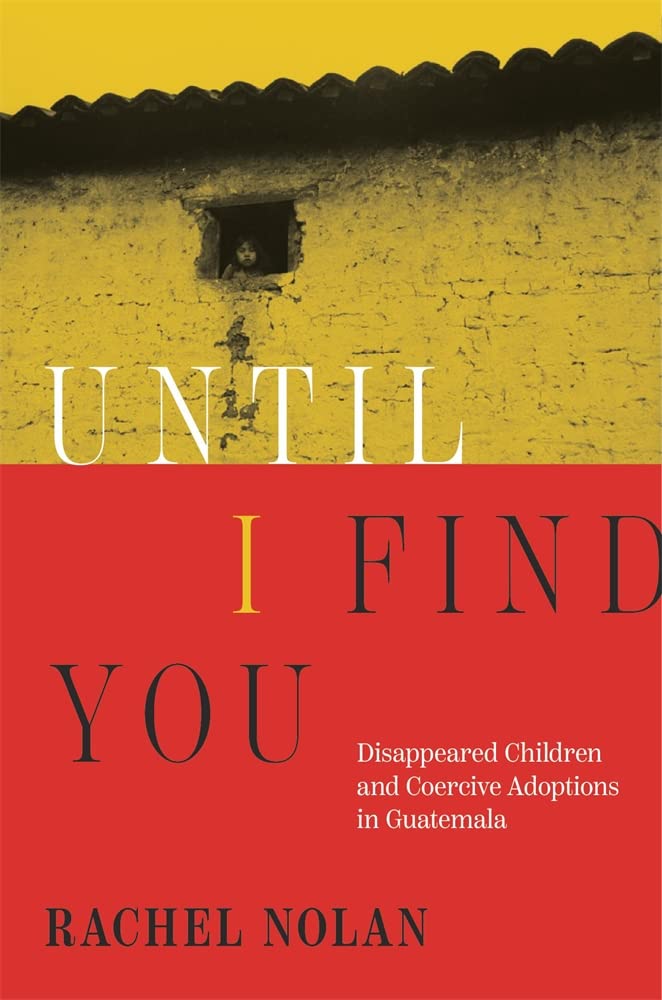
From Guatemala, a Central American country whose recent past is marked by war and volatility, comes a highly readable history of coercive adoptions and forced disappearance of children.
Guatemala’s history and politics might not be mainstream knowledge in the UK, though brief glimpses into the landscape and people have recently come through Race Across the World. With Until I Find You, journalist and historian Rachel Nolan covers three decades of adoption practices in Guatemala. Nolan’s book draws on extensive research in state archives, oral history, as well as adoption files that were briefly open for investigations into war crimes. A casual reader needs no prior knowledge of the subject matter; this highly readable, well-researched account of investigations lends itself well to a lay audience. This book was a finalist for the 2025 Pulitzer Prize for General Non-Fiction.
Nolan traces the origins of Guatemala’s international adoption industry to the early days of the country’s military dictatorship. Extreme violence perpetrated by the government against its civilians, especially Indigenous people, created conditions crucial for “producing adoptable children”. These conditions were reinforced after an earthquake left around one sixth of the population homeless and the country attracted international attention.
Against this backdrop comes an insightful, engrossing account of the development of adoption practice, often involving children who were forcibly disappeared. Despite the possibly unfamiliar context, a familiar phrase emerges: the best interests of the child. As elsewhere, the enforced removal of children from one family into another is often portrayed as an act of aid. After military repression and massacres renders children unable to name their home village or their parents’ names, Nolan highlights how their traumatised silence becomes the basis for “legal abandonment”, and thus eligibility for the international adoption scheme.
Foreign families adopted from Guatemala throughout several decades, each covered in detail using both archive material and interviews. Lawyers might be interested in a key section explaining how the country’s bar association lobbied in the interests of the profession. There, as here, lawyers are notaries and notaries are lawyers. In Guatemala, the role of notary public is a powerful one. Nolan describes how the bar association drafted legislation, which it provided to Congress, proposing that notaries assume responsibility for uncontested family procedures previously overseen by a judge. The rationale was to reduce the burden on courts and allow a notary, “as a subsidiary of the judicial branch”, to more rapidly settle matters. Once passed, the legislation allowed lawyers to represent both adoptee and adoptive families, completing adoptions without judicial oversight.
Removing this oversight might well have sped up the process; it also commercialised the market, with privatisation contributing to growth. The sheer scale of the industry is striking: between 1977 and 2007, Guatemala became the second largest source of international adoptions in the world. As the industry peaked in the 2000s, one in 100 children born in Guatemala was placed for adoption abroad.
Although its principal focus is on the internal dynamics of one ‘sender’ state whose children are adopted out, Until I Find You offers a valuable insight into broader developments in inter-country adoption. In 1993 the Hague Convention on Protection of Children and Co-operation in Respect of Intercountry Adoption was the first global legal framework for the protection of the rights of children, birth parents and adoptive parents. Here we see a private international law solution – administrative cooperation – created to tackle an international societal problem.
Guatemala’s full acceptance of the 1993 Convention was complex: the country’s accession was followed by a constitutional court decision that the accession was unconstitutional (though valid at the international level). After Congress approved Guatemala’s accession, the Convention became part of the domestic legal order on 31 December 2007. Until then, or rather until the Convention entered into force between Guatemala and the United States on 1 April 2008, thousands of children were adopted abroad every year. Towards the end of her book, Nolan weaves the stories of specific cases through these legal developments, bringing the reader into the present day efforts of some individuals to retrace their roots.
Until I Find You: Disappeared Children and Coercive Adoptions in Guatemala by Rachel Nolan. Published by Harvard University Press, 320pp, £30.

Share this article:

Subscribe to our newsletter to not miss articles like this one:
 SUBSCRIBE