


Written by:

Review: A well-paced account of the captive years of Mary Queen of Scots
 Reading time: 6 minutes
Written by:
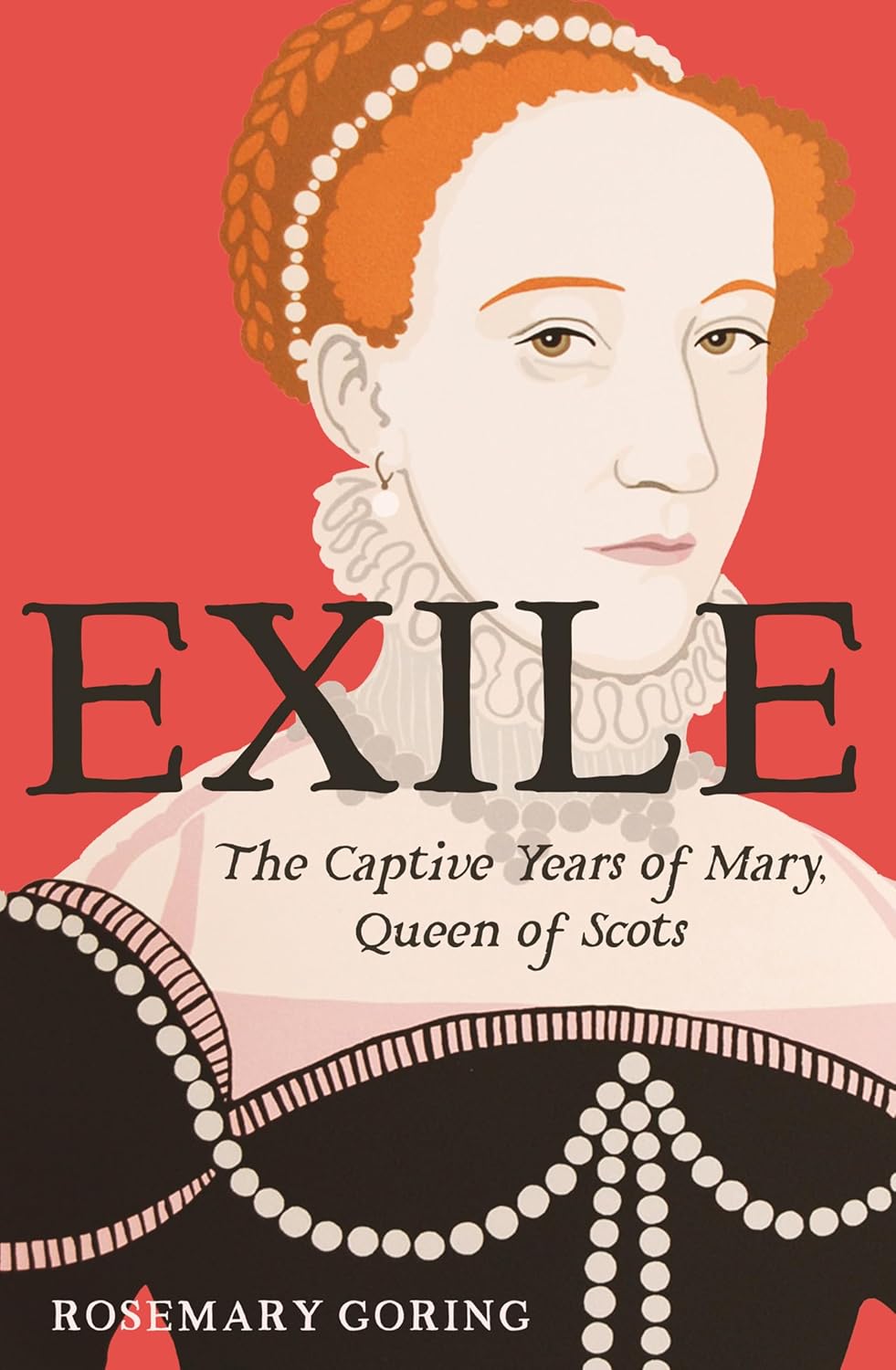
The die was cast for Mary Queen of Scots on May 16th 1568 when she crossed the Solway into England a few days after the Battle of Langside. Some sought to dissuade her. Archbishop Hamilton even seized the reins of her horse and begged her not to trust herself to England.
Mary would have none of it, reasoning in her own mind that her cousin Elizabeth would surely offer her some sort of protection and help her to reunite with her baby son, James. Instead, she would be subjected to almost 20 years of remorseless persecution, followed by execution at the age of 44. She was never to see her son again.
Rosemary Goring has written extensively on Mary Queen of Scots, adding to a canon which began with Antonia Fraser’s 1969 defence of her as a Catholic heroine. Exile offers a perspective which is as close as we can get to considering her final predicament in something akin to an imagined legal framework, though this can only be a concept so in abstracto that it can hardly be regarded as a reality.
There was no due process available to Mary, nor were there any precedents to cite. A tribunal held at Westminster at which the notorious Casket Letters were revealed saw her denied the opportunity to present her own defence, while hostile witnesses were free to vilify her. The one solid piece of legal advice she had been given was in 1566, when the jurist Edmund Plowden wrote a defence of her ‘superior’ claim to the English throne – a proposition which could hardly have endeared her to her cousin Elizabeth.
Mary’s misfortunes were all too often of her own making. The catastrophic litany included marrying Lord Darnley, then marrying the man who had helped to carry out his murder. Nor did it help that, rightly or wrongly, she would herself be implicated in the explosion at Kirk o’ Field which left her widowed.
Isolated by her Catholicism in post-Reformation Protestant Scotland, she had few dependable allies, among the least dependable being her half-brother James Stewart, Earl of Moray, who would end up betraying her. She was frequently denounced from the pulpit by John Knox, who regarded her as chief among the ‘monstrous regiment of women’ whose right to rule was not in accord with Biblical teaching. In his First Blast of the Trumpet, Knox had argued in detail against the more tolerant hypotheses of Calvin and others. For Knox, misogyny was an article of faith.
Exile could so easily have been a litany of misery and anguish, but in the hands of a well-honed storyteller like Rosemary Goring, whose other activities include adapting fiction for 15-minute Radio 4 slots, it even has its lighter moments. We discover that when her son, at the age of five, was coached by his grandfather, the Earl of Lennox, to deliver his first official speech to Parliament, he was preoccupied not so much by affairs of state, as by the fact that there was a hole in the tablecloth. He declared his disapproval to the assembled dignitaries, who were no doubt charmed and amused. Others took a less charitable view of the infant James – to Elizabeth, he was “that false urchin”.
Unavoidably, the book is about the interplay between two complex and strong-minded women, and thus, to a lesser degree, it biographies the English Queen, as well as her Scottish counterpart. Elizabeth’s attitude to her good-looking precocious younger cousin was naturally coloured by her own circumstances. While she could put on a good show, as when she declared to her assembled troops at Tilbury that, despite being ‘a weak and feeble woman’, she had ‘the heart and stomach of a king’ such outbursts of bravado were rare.
To say Elizabeth had a traumatic childhood would be something of an understatement. She was two years old when her mother Anne Boleyn was beheaded on the orders of her father, and she herself was declared illegitimate. When her Catholic half-sister, Mary, became queen in 1554 and carried out a series of brutal Protestant purges, Elizabeth was imprisoned for a time in the Tower of London. In 1559 she inherited a country wracked by civic and religious strife and set about returning it to Protestantism.
Elizabeth’s personal life was beset with problems. She was close to Robert Dudley, Earl of Essex, but when his wife, Lady Amy, was found dead at the bottom of a flight of steps, suspicion fell upon them both, and their relationship, which was probably platonic, was terminated. Her interminable struggle to find a suitor appropriate to her status was a frustrating failure. She would finally give up and ‘marry England’, though as a childless virgin queen she was clearly haunted by the challenge posed by Mary and her ready-made male heir, James. She carefully avoided meeting either of them.
Mary was also constantly under the surveillance of Elizabeth’s formidable spymaster, Sir Francis Walsingham, and his extensive network of informants and double agents. Walsingham soon came up with a scheme to entrap Mary in a conspiracy which was being hatched by a servant of one of her captors, the Earl of Shrewsbury.
Anthony Babington and his fellow plotters had proposed murdering Elizabeth and freeing Mary with the assistance of the French. Under the close scrutiny of Walsingham news of the plot was communicated to Mary, who then wrote a fateful letter of encouragement, asking that she should be rescued before any attempt on Elizabeth’s life. This would turn out to be her second-greatest mistake, the first being her decision to flee to England in 1568.
Walsingham now had an incriminating document in Mary’s own hand which would inevitably lead to the scaffold. She had sealed her own fate. The agent who passed it on to Walsingham added his own coda – a sketch of a gallows. Babington and six of his fellow conspirators were duly sentenced to be hung, drawn and quartered – a fate which no doubt concentrated Mary’s mind.
Her years of exile came to an end in the great hall of Fotheringhay Castle, where her ‘trial’ took place. Mary argued that, as a sovereign, she was entitled to be judged by a jury of her peers, and since Elizabeth was the only peer available, then she must be the one to hand down the verdict. In the event, the outcome was a foregone conclusion. She had no counsel to defend her, and there would be no witnesses for the defence.
Rosemary Goring’s well-paced account of the perfunctory legal proceedings leading up to her botched execution has a certain Runyonesque quality which captures the immediacy of a moment long gone. The Queen may be dead, but her legend lives on.
Exile: the captive years of Mary Queen of Scots by Rosemary Goring. Published by Birlinn, 368pp, £20.

Share this article:

Subscribe to our newsletter to not miss articles like this one:
 SUBSCRIBE