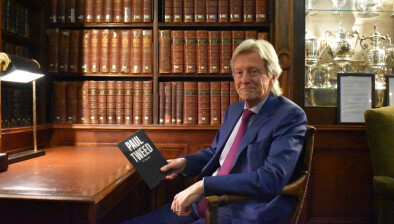


Lord Pentland: AI could lead to faster and more efficient justice system
 Reading time: 4 minutes

The use of AI in the justice system is here to stay and will not “spell the end of judges and lawyers”, the Lord President, Lord Pentland, has predicted.
Lord Pentland provided a unique insight into the benefits and risks of using the new technology in an address at the Royal Faculty of Procurators in Glasgow (RFPG).
He said that while the AI revolution poses real challenges and risks, it should be recognised that the technology is already being widely used in Scotland and court systems around the world.
The Lord President’s comments come after Lord Reed, President of the UK Supreme Court, recently warned the courts may have to “fight fire with fire” by deploying AI in response to a “huge increase” in claims.
Lord Pentland said that AI offered the opportunity to provide access to justice more quickly in a more cost-effective way.
He referred to a recent report, the UK and Ireland Legal Insights Report 2026, which found that 89 per cent of 500 legal professionals surveyed use AI in some capacity.
The Lord President revealed that the Scottish Courts and Tribunals Service is already using natural language processing and generative AI technologies to enhance the efficiency and accuracy of transcription, summarising and translation services.
This is in addition to using AI to support the submission of online forms in civil actions – innovations expected to achieve efficiencies and improve court services.
The Lord President said: “In an age where many people, particularly younger people, no longer rely on traditional channels to obtain information, we must be prepared to think creatively about how to ensure that all sections of the public understand the importance of the independent justice system for them. So where does this leave us?
“It is not beyond contemplation, that a possible future may emerge whereby the vast majority of civil disputes might be resolved between parties in ways that bypass the traditional Courts altogether. Where that alternative system is faster, cheaper to use and its outcomes are easier to understand and predict.”
He added one of the biggest challenges for judges is making the best use of the limited time available to them and predicted that using AI, to sort and prioritise cases or summarise lengthy materials, will help judges get to the core issues more quickly when making judgements.
However, the Lord President warned that while AI should be used as a supplementary tool “Judges must not outsource their thinking to an algorithm”.
He also highlighted the rise in unrepresented members of the public and organisations using AI tools to submit often inaccurate material to the courts, which is impacting on justice being dispensed quickly.
In Scotland, larger law firms are already using AI for traditional tasks, such as legal research and drafting, that would previously have been the remit of junior lawyers. Contracts are now produced using AI and legal problems are also put through analysis on AI.
Lord Pentland added: “My working assumption is that AI is entering the courtroom to stay. All judicial officeholders must be ready, able to understand it and make appropriate use of it. That inevitably means the profession must adapt. To paraphrase a famous saying: ‘You may not be interested in AI, but AI will soon be interested in you’.”
A recent report by French legal thinktank, Club des Juristes, suggested that compensation for personal injury should be determined by AI. Lord Pentland also pointed to the success of tech companies, such as eBay and Amazon, in offering AI driven online dispute resolution systems.
He said that while there are many benefits to the advances in AI technology, it must be designed, and used, in a way which respects the rule of law. He highlighted well-documented concerns that AI tools can replicate, and even exacerbate, human biases.
John Bett, Dean of the RFPG, said: “The use of artificial intelligence across society is moving at such a pace there is no doubt the technology is here to stay.
“The Lord President provided a fascinating insight about how AI is already being used in the justice system in Scotland and around the world.
“The question for those in the legal community is how we use it in a responsible way while maintaining public trust. The Lord President’s guidance and experience will be paramount in helping lawyers weighing up the benefits and risks when deciding how to use AI.”

Share this article:

Subscribe to our newsletter to not miss articles like this one:
 SUBSCRIBE