


Written by:

Kapil Summan
Editor
Overwhelming support for investigation into judge over anomalies in Peggie ruling
 Reading time: 5 minutes
Written by:
Kapil Summan
Editor

An overwhelming number of respondents to an SLN survey think Judge Alexander Kemp should be investigated over anomalies in his judgment in S Peggie v Fife Health Board and Dr B Upton.
We received 1,000 responses to our poll. The vast majority, 945, ie 94.5 per cent, agreed that the appearance of fabricated quotations in the ruling warrants investigation.
The minority, 55 people, or 5.5 per cent, disagreed.
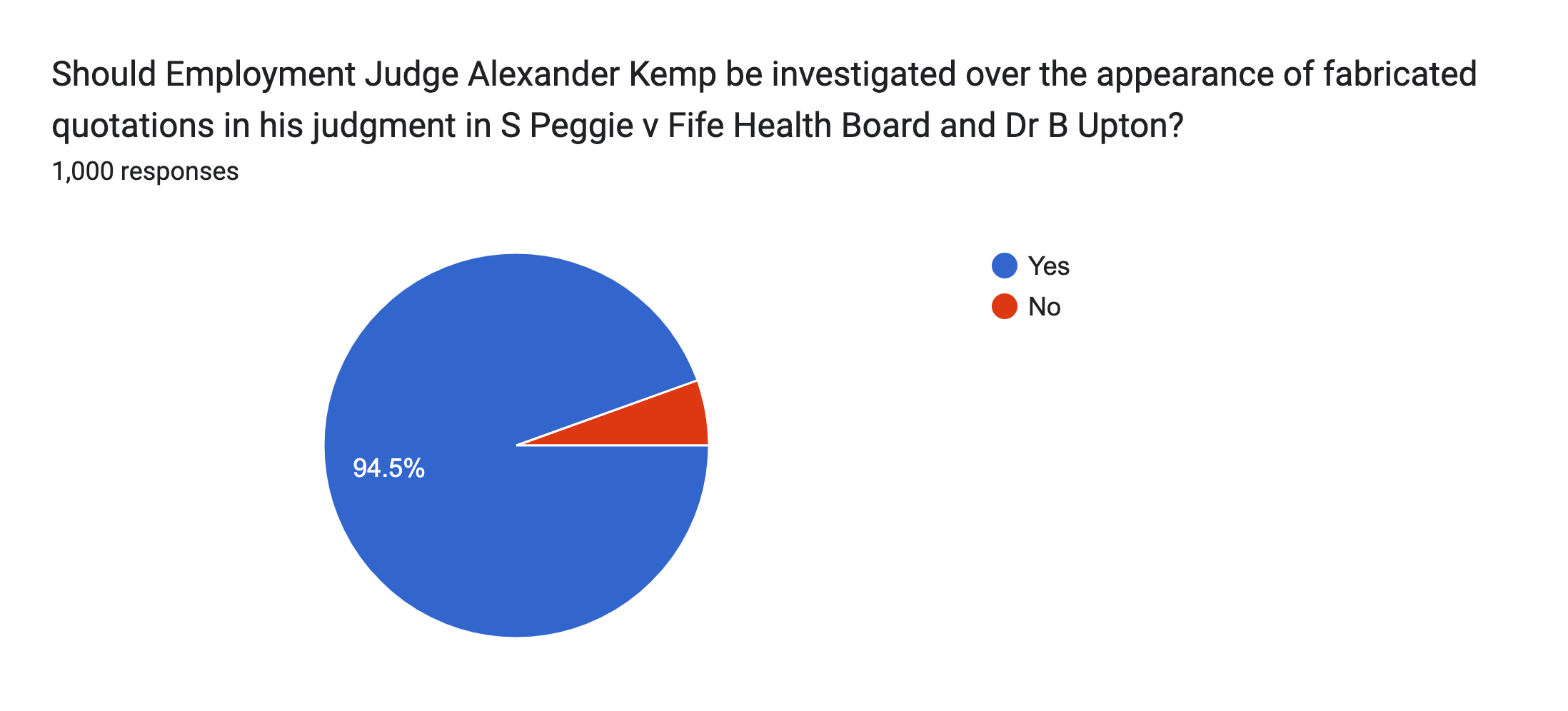
Many respondents who said there should not be an investigation argued that the Employment Appeal Tribunal will address problems with the judgment. But that depends on whether the problems arising from the possible use of AI in the ruling are construed as a matter confined to the judgment or one of personal behaviour. And that is not yet clear because it has not happened before.
Those answering ‘no’ were generally appalled at the idea of an investigation into a judge and equated it with an attack on the judiciary. But judges are investigated over their personal behaviour – that is why mechanisms for doing so exist.
One “practising KC” answered ‘no’ because only one fabricated quotation had appeared in the media.
Another comment stated that “of course Judge Kemp shouldn’t be investigated” and that “even if AI has been used in drafting the judgment, this is not prohibited”. In September this year, your site reported the case of P Evans (as executrix of HB Evans, deceased) & Ors v The Commissioners for HMRC [2025] UKFTT 1112 (TC) where AI was explicitly used.”
We did. We reported that in that decision Judge Christopher McNall, stated: “I have used AI in the production of this decision… Principally, I have used AI to summarise the documents, but I have satisfied myself that the summaries — treated only as a first-draft — are accurate.” He added: “This decision has my name at the end. I am the decision-maker, and I am responsible for this material.”
In its report on the rule of law published earlier this year, the Constitution Committee of the House of Lords – citing my evidence to the committee – noted that media coverage of judicial errors could itself be construed as defending the rule of law – something sharply distinguished from attacks on judges for the outcome of their rulings. And in June this year, a judgment handed down by the English High Court, in Frederick Ayinde v The London Borough of Haringey, warned lawyers of the consequences of misusing AI. President of the King’s Bench Division, Dame Victoria Sharp, stated: “Placing false material before the court with the intention that the court treats it as genuine may, depending on the person’s state of knowledge, amount to a contempt.”
Another ‘no’ voter said something we can all agree on: “What is needed is some firm guidance to all parts of the profession about the use of AI. This particular judge’s misuse of the technology simply reflects the profession’s unpreparedness for it.”
One reasonable comment read: “AI can be a good servant, albeit sometimes an unreliable one, but is a terrible boss. The objection is not primarily to the use of AI but to uncritically sloppy use of AI. If you cannot use it effectively, you should not use it at all.”
As for ‘yes’ votes, one comment read: “Professional practice obligations for the legal profession are no joke. A solicitor could be sanctioned for removing words from case law quotations and changing the meaning, why should a judge be any different? Also, the legal costs in this case will be approaching £1 million already. Half of that covered by the public purse, half by the claimant. What if the claimant couldn’t afford to appeal? The time it will take the legal team to untangle and argue their case will be massively increased because of the judge’s multiple mistakes. Surely there has to be some action taken to mitigate the massive legal bill, and the dent in confidence in the legal process?”
“This judgment brings the judiciary into disrepute and undermines confidence in our system. A formal, independent investigation is absolutely necessary,” stated another.
Said one respondent: “An investigation is necessary, because the use of fabricated quotations erodes people’s faith in the law.” And another: “Trust in the impartiality and precision of the judiciary must be maintained in a democratic society.”
One university employee claimed that “any student using fabricated quotes in an assignment would be investigated” – which implies a lot of investigating taking place in universities.
A lawyer responded: “As a solicitor in England, it’s clear to me that we must take a UK-wide approach to fighting inappropriate AI use in all the jurisdictions.”
A very sensible comment read: “This is a win for none of the parties involved in this dispute. Even Dr Beth Upton’s team must be dismayed with a decision which despite ruling in their favour, is based on shaky ground and is obviously very appealable.”

Share this article:

Subscribe to our newsletter to not miss articles like this one:
 SUBSCRIBE