
Delict appeal to Supreme Court over alleged wrongs of former sheriff dismissed
 Reading time: 7 minutes
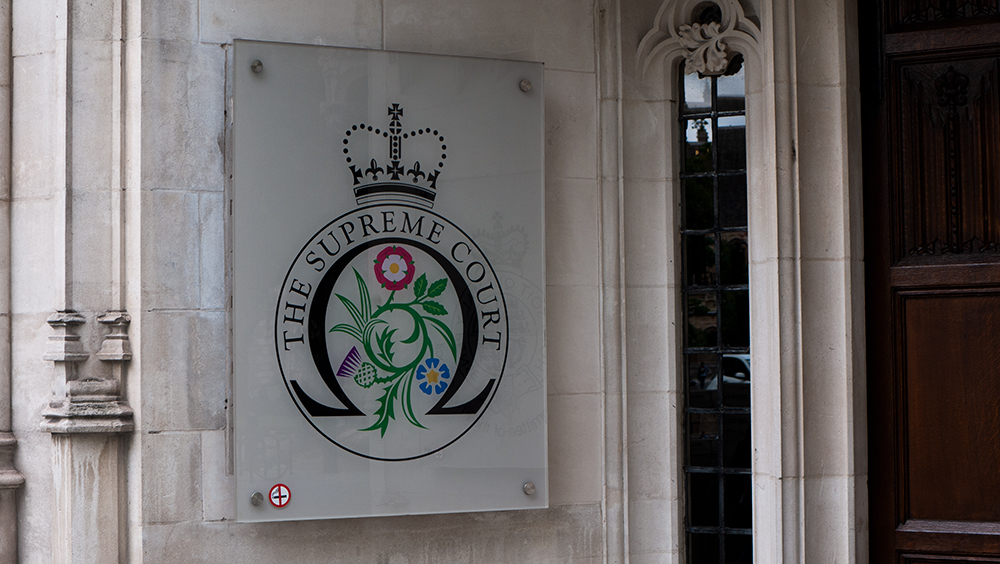
An appeal by a legal practitioner who claimed that the Crown was liable in delict for alleged civil wrongs committed by a former sheriff has been unanimously dismissed by justices in the Supreme Court on the basis it was bound to fail at the first stage of the vicarious liability enquiry.

About this case:
- Citation:[2025] UKSC 44
- Judgment:
- Court:UK Supreme Court
- Judge:Lord Reed and Lord Burrows
Lord Reed and Lord Burrows gave a joint judgment, with which Lord Hodge, Lord Briggs and Lady Simler agreed.
The pursuer alleged she was assaulted on three separate occasions by John Brown when he was a sheriff. Two of those were in the court building where Mr Brown sat as a sheriff and the third was on a train. He also tried to contact her on her mobile phone, after she complained about his behaviour. The pursuer alleged that the sheriff was liable for those assaults and, taking the four incidents together, for harassment contrary to the Protection from Harassment Act 1997.
The factual question whether Mr Brown committed the alleged delicts has not yet been decided. This is because the courts were first asked to decide the preliminary question whether the Crown can be held vicariously liable for Mr Brown’s delicts, should they be proven at trial.
In general terms, vicarious liability imposes a liability to pay damages on employers where their employees have committed a delict within the course of their employment. There are two stages to the vicarious liability enquiry. Stage one is concerned to establish whether there is an employment relationship or a relationship “akin to employment” between the wrongdoer and the employer or, if the relationship is akin to employment, quasi-employer. Stage two is concerned with whether the delict or tort was sufficiently closely connected to what the wrongdoer was authorised to do that it can fairly and properly be regarded as done by the wrongdoer while acting in the course of the wrongdoer’s employment or quasi-employment.
On this appeal, stage two was no longer in dispute. That is, it is accepted that, if the pursuer succeeds at stage one, the case should go to trial because she is not bound to fail at stage two.
The Outer House of the court of Session held that she was not bound to fail at stage one. But that decision was overturned by the Inner House. The pursuer thereafter appealed to the Supreme Court.
The central issue in this appeal was the correct interpretation of section 2(1)(a) of the Crown Proceedings Act 1947. Under section 2(1)(a) read with section 43(b), the Crown may be held vicariously liable in respect of torts and delicts “committed by its servants or agents”.
What does ‘the Crown’ mean in the context of this case?
The Supreme Court held that, in section 2 of the 1947 Act, “the Crown” means the Sovereign in his official capacity. The court’s view is supported by the provisions of the 1947 Act, which make clear that government ministers and departments, and members of the Scottish government and parts of the Scottish administration, are servants of the Crown, not the Crown itself.
Other provisions of the 1947 Act recognise that the Crown acts in different capacities. Further, section 30 of the Interpretation Act 1889, which was in force at the time when the 1947 Act was passed, laid down that, unless the contrary intention appeared, references to the Crown in any Act of Parliament were to be construed as meaning the Sovereign for the time being.
The Crown has been correctly described in the case law as a corporation sole: a legal entity with perpetual succession constituted by a single person, namely the Sovereign for the time being. This is consistent with familiar aspects of the constitution, such as the continuity of office of the Sovereign on the death of the natural person holding that office for the time being. It reflects the fundamental distinction between the two capacities of the monarch: as a private individual, on the one hand, and as the holder of a public office on the other [40].
The Crown’s liability under the 1947 Act does not extend to all of the Sovereign’s official capacities, which are wide-ranging. Section 40(2)(b) of the 1947 Act makes clear that the liability of the Crown must arise in respect of His Majesty’s government in the UK or the Scottish administration.
Whom should the pursuer sue?
The Supreme Court agreed with the lower courts that the pursuer’s vicarious liability claim was correctly brought against the lord advocate. The Crown can only be sued under the 1947 Act in respect of liability arising in respect of the UK government or the Scottish administration. In the present case, the focus must be on the Scottish government (which forms part of the Scottish administration) because the Sovereign in his official capacity acts through the Scottish government as regards the relationship with Scottish judicial office-holders. The Scottish government pays judges’ salaries and, through the first minister, is responsible for the appointment and removal of judges. So, the relevant relationship for the purposes of the stage 1 test for vicarious liability is the relationship between the Scottish government and the sheriff. Under sections 1 and 4A of the Crown Suits (Scotland) Act 1857, the lord advocate is the appropriate defendant in claims against any part of the Scottish administration.
What is the relationship between section 2(1)(a) of the 1947 Act and the common law test for vicarious liability?
The Supreme Court rejected the pursuer’s principal argument that section 2(1)(a) is self-contained. Section 2 carves out a number of wide exceptions to the general principle that the Crown cannot be held liable in delict or tort. For each of these areas of liability in delict or tort, section 2 puts the Crown in the same position as “if it were a private person of full age and capacity”. So, the common law of vicarious liability applies to the Crown in the same way as it would to a private person. This includes the recent development of the common law at stage 1 to embrace a relationship that is akin to employment. Since a statute is “always speaking”, an interpretation that embraces developments in the common law is generally preferable to one that treats the interpretation of the statute as frozen in time.
The Supreme Court also held that stage one of the test for vicarious liability was not satisfied because the relationship between a sheriff such as Mr Brown and the Scottish government is not akin to employment. This is the case even though the Scottish government, through the Scottish Consolidated Fund, ultimately funds sheriffs’ salaries, allowances and pension benefits. It follows that the Crown cannot be held vicariously liable for Mr Brown’s alleged wrongdoing.
The court gives two linked reasons for this conclusion. First, the Scottish government has no control over the sheriffs’ performance of their judicial functions. Second, and most crucially, it is a constitutional principle, resting on the separation of powers, that the judiciary is independent of government. The principle of judicial independence is enshrined in section 3 of the Constitutional Reform Act 2005 and in section 1 of the Judiciary and Courts (Scotland) Act 2008. The Scottish government cannot, therefore, tell a sheriff what to do or how to do it. A sheriff must be free to decide cases – including cases where the Scottish government is one of the parties – without any interference or fear of interference.

Share this article:

Subscribe to our newsletter to not miss articles like this one:
 SUBSCRIBE