

David J Black
 Reading time: 8 minutes
David J Black
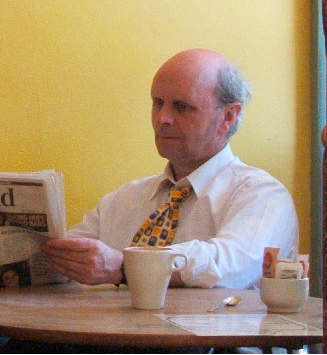
With the kind permission of The Times, Scottish Legal News reproduces below the newspaper’s obituary of David J Black. David was a gifted writer whose many pieces for us over the years, whether they followed the money or lampooned hypocrites, evoked both fervent endorsement and opposition. No one could say, however, that they were not written with the elegance and wit of a bygone era. He will be dearly missed.
Saving Edinburgh’s architectural heritage has been a fighting cause ever since the lawyer and campaigner Lord Cockburn inveighed against the failure of the city fathers in the 18th century to protect its finest buildings. “Edinburgh,” he wrote, “is not exempt from the doom that makes everything spoilable.”
David Black was a worthy heir to the Cockburn tradition. His lifelong dedication to exposing, facing down and preventing commercial developments that threatened the graceful fabric of the city was legendary. He saved many of the buildings and quarters that make Edinburgh one of Europe’s great architectural creations, but which successive city planners seemed all too ready to sacrifice in the name of progress.
His weapons included the use of scathing vocabulary to describe the worst excesses of the developers, and the recruitment of celebrities, including royalty if necessary, to stay the wrecking ball. His most famous, and largely successful, campaign was mounted against the demolition of an entire historic area on the south side of Edinburgh, to provide accommodation and offices for its university. Black targeted the London architect, Sir Robert Matthew, whom he described as “the Bomber Harris” of the enterprise. “Neighbourhoods would be flattened …” he warned. “Familiar landmarks would blink uncertainly at a setting of bland concrete blocks.”
He persuaded the future prime minister Gordon Brown, then the rector at the University of Edinburgh, and Brown’s girlfriend Princess Margareta of Romania to join the cause, and reported that she had “bent the ear” of her godfather, the Duke of Edinburgh, who was the university’s chancellor. The duke, said Black, had “turned faces ashen-white when he asked what the hell was going on”. Not everything was saved, but the Southside Association, which he co-founded and chaired, was successful in heading off the worst of the proposals.
Later, when plans were put forward to develop the Old Royal High School on Calton Hill, designed by the architect Thomas Hamilton, and turn it into a 120-bedroom hotel, Black killed the project stone dead when he described the project as “like putting Mickey Mouse ears on the Mona Lisa”; instead the building is to become a centre for musical training and education.
Not all his campaigns succeeded. He failed to stop entirely the new Virgin hotel in the Cowgate, which threatened to block the light from the large windows of Andrew Carnegie’s central lending library, despite the motto carved above the door announcing “Let there be light”; and he was unable to forestall the erection of the W Hotel in the St James’s Quarter, with its rooftop ribbon design that its defenders coyly referred to as “the walnut whip,” but which Black dismissed as “the golden turd”.
To all his campaigns he brought a deep historical knowledge, and a passionate attachment to the aesthetics of the city. As his artist friend Hugh Buchanan put it: “David was phenomenally well informed on all things architectural. He was the intellectual ballast to all Edinburgh’s most important heritage campaigns.”
David John Black, born in 1947, grew up in a pre-fab house in the Craigmillar area of Edinburgh, the eldest of three children born to Jack Grant Black and Wilhelmina (Winnie) Douglas Prentice. Jack was a bus driver, later transport driver organiser for the Edinburgh bus company, and a justice of the peace, who had served in the Fleet Air Arm during the war. Winnie was a Labour councillor, who later switched to standing as an independent, and became a community organiser. After Winnie’s death, Jack married Natasha, a Russian who had been a translator at the Nuremberg trials, who lived to the age of 100.
Educated briefly in Halifax, Yorkshire, then Peffermill school in Edinburgh, he progressed to George Heriot’s, from which he ran away, to finish his education at Napier College (later university). Black’s first job was as assistant drayman at St Cuthbert’s Co-op dairy, in the days when milk was delivered by horse. He went up to St Andrews University, but left after a few weeks, as he put it “to muck out camels”, though where and why he did this is not explained.
Returning to Edinburgh in the 1960s, he became involved in the arts scene that had followed the creation of the Edinburgh International Festival, and the burgeoning Fringe. He worked at the Traverse Theatre club for many years as a lighting technician, getting to know many of the visiting performers, including Robbie Coltrane, Billy Connolly, David Bowie, and the poet Hugh MacDiarmid.
The 1960s was a period which saw commercial and transport development sacrificing much of the heritage of Scotland’s cities. Motorways were driven through Victorian Glasgow and shopping centres took precedence over heritage buildings in Dundee. Edinburgh was not immune, and Black was horrified by the threat commercial development posed to its architectural character. He noted the success of the Edinburgh Georgian Society, founded by Eleanor Robertson to campaign against what she described as “an unholy alliance” between Edinburgh’s university and the city corporation to destroy George Square.
He went on to co-found and chair the Southside Association, created in 1972, which was central to his largely successful campaign to prevent the demolitions which would have taken place if the university’s development plans on the south side of the city had been allowed full rein. He co-founded the Old Town Association, and was deeply involved in other conservation bodies, such as the Cockburn Association, the Scottish Historic Buildings Trust and the Architectural Heritage Society of Scotland.
Amongst the notable buildings he saved was the Hermits and Termits Georgian villa on St Leonard’s Street, so called after the 15th-century crofts linked to Holyrood Abbey. It was due to be pulled down until Black intervened. Later it was restored by the architect Ben Tindall.
In 1987 he married Alison Harley, and they had three sons: Hugh, a Latin teacher; Adam, previously a writer and poet, now sadly a long-term in-patient at the Royal Edinburgh Hospital; and James, an economist at the Fraser of Allander Institute. The couple separated in 2005, and were divorced in 2009. For ten years the family lived at Smailholm House, a historic 17th-century laird’s house in the Borders, which Black spent 20 years restoring, before selling it and buying a house in Edinburgh’s fashionable Ann Street.
The experience of restoring Smailholm kindled Black’s interest in sourcing the original fittings of old houses, and led to him co-founding and running a company called Thistle & Rose, which restored and produced facsimile historic mantelpieces for buildings in Scotland and abroad. A frugal character, he got by without much regular income, but did well out of property, often buying and selling at the right time, restoring as he went. He worked with antique shops, fine art galleries and dealers, and was active in cultural enterprises, such as the conversion of the Queen’s Hall into a classical music hall, and Summerhall, which became a Fringe venue.
He also wrote on architecture and property for the Sunday Times Scotland, Scotland on Sunday and the Daily Mail; he ran a campaigning series in Scottish Field called Heritage at Risk; and contributed articles on politics and heritage for the online publication Bella Caledonia and the Scottish Legal News.
His one-woman play Nancy’s Philosopher on the love life of David Hume ran at Summerhall during the 2016 and 2025 festivals. He published three books: Flesh and Blood, a book of short stories; The Virgin Good Junk Guide, a guide to British antique shops and auction houses; and All the First Minister’s Men, on the delays and overspending on the new Scottish parliament building at Holyrood.
His death from prostate cancer came before the planned publication of a book on the chronic fatigue syndrome which afflicted his son Adam who along with his two brothers, Hugh and James, survive him. Black is also survived by his brother, Kenneth, and sister, Helen.
Black’s dedication to conservation, but also the wry humour he brought to so many of his causes, won him a large circle of friends, and though they did not always share his tireless enthusiasm, they admired his perseverance. He carried on campaigning right up to his death, his last battle being against the recent proposal to convert 18th-century buildings on Atholl Crescent into a proposed 544-bed “capsule pod” hotel. It is just the kind of cause he would have fought and almost certainly won.
David J Black, urban campaigner, was born on December 5, 1947. He died of prostate cancer on February 26, 2026, aged 78.

Share this article:

Subscribe to our newsletter to not miss articles like this one:
 SUBSCRIBE