Is this email not displaying correctly? View it in your browser.
30th May 2025
Scotland's news service for lawyers
Today’s Headlines
Latest News

20-year-old who abducted teen with cerebral palsy, sexually abused him and threatened him with BB gun loses appeal against sentence

By Mitchell Skilling

20-year-old who abducted teen with cerebral palsy, sexually abused him and threatened him with BB gun loses appeal against sentence

A 20-year-old man who received an order for lifelong restriction after abducting a vulnerable teenager, threatening him with a BB gun, and forcing him to perform oral sex has lost an appeal in the High Court of Justiciary against his sentence.

Appellant NS, who was 18 when he committed the offences, argued that the sentencing judge had put undue weight on the sexual element of the offences in determining that an OLR was appropriate. The judge fixed a punishment part of four years, backdated to December 2022 following the appellant’s remand in custody and interruption by a nine-month detention for another charge.

The appeal was heard by the Lord Justice Clerk, Lord Beckett, with Lord Matthews and Lady Wise. Moggach KC appeared for the appellant and Stalker AD for the Crown.

Continued denial

In July 2022 the complainer, who was aged 18 and disabled with paraplegia on his left side resulting from cerebral palsy, attended a small party at the home of a female friend at which the appellant also attended. The complainer had intended to stay the night at the party house but there was no bed left. He accepted the appellant’s invitation to stay at his flat, arriving there at about 1am. The appellant showed him to the living room and went elsewhere.

When the appellant returned, he was wearing a balaclava and holding a BB gun, which the complainer thought was real. In his evidence, the complainer said that the appellant repeatedly hit him on the head whilst holding the gun, and that he was forced to undress and masturbate the appellant whilst being mocked for his disability. After punching him and knocking him out a few times, the appellant forced the complainer to perform oral sex on him. At about 7 or 8am, the complainer escaped, the appellant having taken his mobile phone after arriving at the flat.

The appellant maintained at trial that the BB gun was used as part of a prank, and that the sexual activity was consensual. It was noted that he had previous convictions for culpable and reckless conduct and assault and robbery, and that he had been known to social workers since the age of 11. It was also noted that when he was 12, his sister reported he had sexually abused her for around a year, which he admitted to the risk assessor.

For the appellant it was submitted that the judge placed undue weight on his view that the appellant’s continued denial of the sexual offence reduces his capacity to respond to rehabilitative measures in determining that only an OLR was appropriate. Whilst it was for the judge to determine the level of risk, he erred on the significance of denial. The court should not place undue weight on what he did to his sister when he was younger, that having been dealt with by the children’s hearings system.

Forensic awareness

Lord Beckett, delivering the opinion of the court, said of the seriousness of the offences: “We take a very serious view of the charges in this case. The acquisition of a balaclava and BB gun and the circumstances in which they came to be used are redolent of premeditation. The appellant showed forensic awareness in committing these crimes. He subjected the complainer, vulnerable by virtue of his disability, to an ordeal of abduction, assault and sexual offending that endured for hours.”

He continued: “The appellant continues to minimise the extent of what he did. He denies abduction and that sexual activity was non-consensual. Persistence in denial at this stage does not necessarily rule out successful rehabilitation but it presents an impediment. The trial judge was not alone in thinking so. It presented considerable difficulty to the risk assessor. The trial judge viewed denial alongside the appellant’s history of sexual offending and other behaviours. There is no reference to the judge’s treatment of denial in the note of appeal and there should have been if the appellant wished to found on it when the judge identified it as a consideration in his sentencing remarks.”

Considering the appellant’s past conduct, Lord Beckett said: “The appellant accepts that he has sexually offended in the past, against his younger sister, and he plainly did so seriously and repeatedly, and against a female member of staff in a children’s home before he committed the serious crimes on this indictment. We do not consider that his premeditated offending, sustained over hours, resulted from his taking intoxicants, even if he had consumed some alcohol and cannabis. Neither he nor anyone else suggests it prompted his behaviour and we reject senior counsel’s suggestion it might have done.”

He concluded: “We recognise that there are some encouraging signs in his attitude and response to the regime in Polmont. We acknowledge that his personality is not fully formed and he may mature considerably. If he does, this may reduce the risk he presents. The judge had to weigh such favourable indications against the appellant’s history of serious sexual misconduct. He was correct to envisage that long-term supervision and monitoring will be necessary on the appellant’s release from prison and that the appropriate means of achieving it, where he was satisfied on a balance of probabilities that the risk criteria were met, was an OLR.”

The appeal against sentence was therefore refused.

MSPs give consent to UK-wide anti-smoking law

MSPs give consent to UK-wide anti-smoking law

MSPs have given their backing to UK legislation intended to create a “smoke-free generation”.

Holyrood passed a legislative consent motion on Thursday, signalling agreement to Westminster legislation that affects a devolved policy area.

The Tobacco and Vapes Bill, which applies across the UK, would prohibit the sale of tobacco products to anyone born after 1 January 2009. It also proposes tighter controls on the advertising and sale of vapes, and a review of e-cigarette packaging.

The bill has cleared the Commons and is currently progressing through the Lords.

Scottish public health minister, Jenni Minto, welcomed MSPs’ unanimous approval of the motion.

She said: “The Scottish Parliament’s consent to this landmark legislation will ensure that children born after January 1, 2009 can never be sold tobacco.

“We have worked closely across the four nations to ensure a consistent approach and I am determined to ensure a tobacco-free Scotland, where people live longer and healthier lives, by 2034.

“The bill, once passed, will also ban vapes and nicotine products from being deliberately promoted and advertised to children, stopping the next generation from becoming hooked on nicotine.

“The Scottish Parliament’s support for this bill will benefit public health in Scotland and will help save lives.”

Andrew Diamond to be Lindsays’ next managing partner

Andrew Diamond to be Lindsays' next managing partner

Pictured: Andrew Diamond and Alasdair Cummings

Lindsays has appointed a new managing partner elect.

Andrew Diamond, currently a partner and the firm’s head of residential property, will take up the role on 1 October.

He will succeed Alasdair Cummings, who is stepping aside after 14 years in the role – a period during which Lindsays has completed six mergers and seen annual turnover grow from £9 million to almost £28m.

A handover process is already underway, following which Mr Cummings will remain a partner.

Mr Diamond, who joined Lindsays through its merger with MacLachlan and MacKenzie in 2012, aims for the firm to continue its growth organically, as well as through mergers and strong strategic hires.

He said: “I am delighted to be taking on this role. I am very much the continuity candidate. And, while in politics that may not always be viewed favourably, it is a good thing for Lindsays. It’s business as usual here.

“We are clear in our identity as an independent Scottish firm, working with Scottish families and businesses. There will be no change to that. We will continue with steady, strategic growth on the same path as we have followed.

“Our culture at Lindsays is our greatest asset. Our people matter. We have the soul of a smaller firm but with all the benefits of scale. That is down to Alasdair’s leadership, for which we are all grateful. I have very large shoes to fill.”

Mr Cummings’ Lindsays story has seen him rise from trainee to managing partner, beginning in 1986, with only a five-year gap during which he worked for a London legal firm before returning to Lindsays in Edinburgh in 1993 to help grow its corporate and commercial law services.

He said: “Lindsays means so much to me. To be Managing Partner of this firm, with its tremendous team, has been the undoubted highlight of my career.

“The past 14 years have been a successful and exciting journey. Together, we have achieved good growth, a wider geographic footprint and become a full-service firm, of which I am incredibly proud. The time, however, feels right for a new voice to lead Lindsays into the next stage of that journey.

“My current three-year term as managing partner was due to end next March and I was always clear that I would not be seeking another. With that in mind, making a change now feels like sensible succession planning. Andrew is a very worthy successor and I look forward to supporting him in any way I can.”

Nina Taylor, Lindsays’ chair, said: “Alasdair has led Lindsays with purpose, professionalism and integrity. His leadership typifies our firm’s people-first approach to everything. Our thanks go to him for the success he has delivered for the firm and our very best wishes go to Andrew as the baton is passed on. The partnership is right behind him.”

Joint managing partners re-elected at Blackadders LLP

Joint managing partners re-elected at Blackadders LLP

Pictured: Emma Gray and Ryan McKay

Joint managing partners Emma Gray and Ryan McKay have been re-elected as leaders of Blackadders LLP for another three years.

Blackadders reported growth in turnover and profit in its latest accounts and expect to report further growth for the financial year ending 31 March 2025, with the un-audited combined income of Blackadders LLP and Blackadders Wealth Management LLP exceeding £19 million.

The year saw significant investment in improving staff benefits, new premises and upgrades to core IT infrastructure. All employees now have access to private health insurance and a medical cash back scheme.

Mr McKay said: “We are pleased and honoured to be chosen to continue to lead Blackadders. The last three years have been hard work but incredibly rewarding and we are proud of how the firm and everyone in the team has performed.

“Achieving the 5 by 25 goals will be tough but they are certainly achievable if we push on in this final year. We are confident the team will continue to operate at the highest level and provide the kind of service which has seen record levels not only of new business but also importantly of returning business.”

Ms Gray said: “We have no intention of standing still. This is an ambitious firm with a team of very talented people and we are confident that we can continue to challenge the way the industry delivers its services and give our clients unparallelled professional support nationally.

“We will be looking to set new goals which will reflect our ambition and the talent we have at Blackadders. Our people, our culture and the manner in which we conduct business are vitally important to us and we want to continue to grow our reputation as well as our financial performance.”

Should schools record and report on the use of restraint and seclusion?

Should schools record and report on the use of restraint and seclusion?

A new bill that provides for the recording and reporting of restraint and seclusion in schools is being considered by a Holyrood committee.

The Education, Children and Young People Committee will be considering the Restraint and Seclusion in Schools (Scotland) Bill, which has been introduced by Daniel Johnson MSP.

The bill aims to minimise the use of restraint and seclusion in schools, as well as stating that schools would need to inform the parent of a child or young person subjected to restraint or seclusion about the incident and annually report on the use of either approach.

Restraint and seclusion have been used in schools to manage children’s behaviour but there have been serious concerns about both practices for several years, with campaigners calling for change.

If the bill is passed, schools would need to be issued with detailed guidance about the use of restraint and seclusion. Schools would also need to inform parents of when restraint and seclusion have been used and maintain a report on the use of these approaches.

The committee would like to understand whether the measures outlined in the bill are appropriate.

Douglas Ross, convener of the Education, Children and Young People Committee: “The use of restraint and seclusion has been controversial for many years.

“This bill aims to minimise the use of restraint and seclusion and we want to understand the implications of adopting this approach on children and young people, parents and professionals.

“The committee is keen to hear from people who have views on the use of restraint and seclusion in schools. We’re also interested in hearing from teachers, school leaders and specialists to give us a broad perspective of views on the proposals in this bill.”

The committee’s call for views is open to responses until 11 July. It is then due to take evidence on the proposals in the bill in the autumn.

Annabelle Gow joins Burnett & Reid LLP

Annabelle Gow joins Burnett & Reid LLP

Pictured: Annabelle Gow

Burnett & Reid has announced that Annabelle Gow will be appointed as a member of the LLP, effective 1 June.

Ms Gow brings over a decade of experience in private client law to the firm, and has been a trusted adviser to individuals and families across the north of Scotland. 

Her practice spans the full breadth of private client work, including wills, powers of attorney, trusts, and estate and succession planning, with particular expertise in supporting elderly and vulnerable clients through sensitive life transitions.

Woman jailed for children’s charity embezzlement ordered to pay back thousands

Woman jailed for children’s charity embezzlement ordered to pay back thousands

A woman jailed for stealing thousands of pounds from a children’s charity and a family-run coffee firm has been ordered to repay more than £36,000 under proceeds of crime laws.

In January 2025, Beverley Bennie, 37, was sentenced to 20 months’ imprisonment after she admitted embezzling a total of £96,371 from Kids Come First and vending firm Myrtle Coffee in Kirkcaldy, Fife.

At Kirkcaldy Sheriff Court on 28 May 2025, the court made a confiscation order in the sum of £36,036 and recorded that the benefit of criminal conduct was £96,371.

She was given six months to pay the confiscation order.

The confiscation order can be revisited if further assets are identified in the future to be paid towards the full amount that was determined as the benefit of the crime.

Sineidin Corrins, deputy procurator fiscal for specialist casework at the Crown Office, said: “Beverley Bennie was convicted of crimes that displayed a betrayal of trust by someone who had financial oversight of funds from a children’s charity and a family business.

“She showed no regard for the impact her crimes would have on vulnerable children or the effect it would have on those trying to run an honest business. We take such criminality very seriously. This confiscation order shows that the Crown will not stop at prosecution.

“Even after that conviction was secured, the Crown pursued proceeds of crime action to ensure funds she obtained illegally were confiscated. Confiscation orders have ongoing financial consequences, meaning we can seek to recover further assets from this individual in the future to reflect the full amount.

“These funds will be added to those already gathered from proceeds of crime and will be re-invested in Scottish communities through the CashBack for Communities programme.”

During a previous hearing, the court heard how Bennie was employed as a business manager with Myrtle Coffee, which supplies wholesale coffee and vending services. Bennie’s job gave her access to the company’s system, and she was responsible for the petty cash as well as an electronic cash account.

The court was told that a fixed float of £20,000 was always held in the company safe and was also the responsibility of the accused. But a financial review in August 2023 found the safe only contained £7,610. An audit then revealed Bennie had carried out numerous fraudulent transactions between September 2017 and September 2023.

Company officials discovered she had inflated the values of genuine receipts, reversed some transactions, fabricated receipts, created false accounts and employed other methods to reduce and manipulate the petty cash balance.

The total amount obtained by the accused was £83,599. The court was also told that in 2018, Bennie took on the role of treasurer with Kids Come First, a charity based at the Benarty Centre in Ballingry, Fife.

In 2021, it was revealed the charity had limited cash reserves and some staff members could not be paid. Fife Council then instructed a forensic accountant to examine the accounts, and the results showed a number of unauthorised cash transfers totalling £12,771 made by accused between December 2020 and September 2021.

Sheelagh Cooley: Appetite for change as investors call for clarity on Scottish real estate

Sheelagh Cooley: Appetite for change as investors call for clarity on Scottish real estate

Sheelagh Cooley

Last week, Sheelagh Cooley, real estate partner and head of the Edinburgh office at Shoosmiths, delivered the keynote speech at the Scotland Investor and Developer Breakfast as part of the UK Real Estate Investment and Infrastructure Forum (UKREiiF, Leeds, 20-22 May). She shared her market insights from the perspective of a legal expert at a firm with deep roots in the Scottish real estate sector. She was joined by Barry McKeown, fellow partner and head of real estate Scotland at Shoosmiths.

As the Greek philosopher Heraclitus observed, ‘change is the only constant’. That sentiment resonated strongly when 40 senior figures, all representative of private and public interests in the real estate sector came together at the invite-only Scotland Investor and Developer Breakfast.

The aim was to foster honest and open dialogue among the diverse group of stakeholders with experience spanning Scotland, the wider UK and international markets.

At a time when Scotland – and the UK more broadly – is navigating economic and geopolitical headwinds, I hoped there would be a measure of agreement regarding the available real estate opportunities, alongside frank roundtable discussions on the key challenges currently holding back greater investment in many Scottish residential and commercial real estate projects.

I need not have worried for it quickly became apparent that many delegates recognised the need for a step-change in approach.

Arguably, that was hardly surprising. While there are some glimmers of economic optimism, particularly around predictions of further interest rate cuts and a cautiously improving sentiment regarding transactions, the over-arching message from many discussions at UKREiiF was clear. Capital is available, but unlocking it depends on restoring market confidence. Macroeconomics, bluntly, is only part of the story.

Delegates at the Scotland Investor and Developer Breakfast shared this sentiment. Many sought real clarity on how to address wide-ranging issues affecting delivery of projects in Scotland’s central belt and beyond, including crippling planning delays, stretched local authority teams and public sector policy uncertainty.

Equally, it was noted and warmly welcomed, that the Scottish Government is placing planning at the heart of its economic strategy. Significantly, the Programme for Government doesn’t just frame planning as a technical process, but rather as a core enabler of broader outcomes, including economic growth and poverty reduction. That’s significant.

Many attendees hoped that this approach could open real opportunities for our industry, to demonstrate how development, when done well, isn’t merely a financial calculation, but a route to creating vibrant and sustainable communities. However, delegates, including council leaders from several Scottish local authorities, recognised that implementation of the government strategy remains challenging. Indeed, a recent Scottish Government review has identified over 20,000 stalled homes across 114 sites.

No-one at the breakfast anticipated that the dialogue would offer quick fixes to the most pressing of issues. However, the chance for the private sector to exchange experiences of the market with public sector representatives, and to discuss key issues and potential ways forward, was positively received.

From a capital perspective, there’s awareness of initiatives such as the Invest Scotland programme and the ongoing support of Green Freeports. Yet there was also a frank assessment that the success of these initiatives will depend heavily on the surrounding infrastructure and housing delivery. The North-East Energy Transition Zone is an example of a project where long-term success will rely on having homes and services in place to support both the construction and operational phases.

Within the residential sector, the appetite to deliver more projects is clear. However, private investors and developers remain acutely aware of the risks involved. While funding is available, they are seeking greater clarity and support from public sector bodies and policymakers to help alleviate those risks.

They know that while in the UK the Build-to-Rent (BTR) sector is booming - with a record £5.2bn invested in 2024 - investment volumes in Scotland have fallen by two-thirds since 2020. Primarily due to uncertainty around rent controls. Private sector delegates, aware how that uncertainty impacts investment in BTR and Purpose-Built Student Accommodation (PBSA) are closely watching developments around the Housing (Scotland) Bill, concerned that extending rent regulation could further stall new developments.

Will proposed rent-cap exemptions for new developments make all the difference to restoring investor confidence? Time will tell.

In a gathering of such influential figures across the public and private sector, it was further recognised that affordable and mid-market housing offered real scope for partnership. The Scottish Government has committed nearly £600m to support new supply this year and is actively seeking institutional investment to scale delivery. This blend of public funding with private capital is already unlocking projects across the country, demonstrating what’s achievable when risks are aligned and objectives shared.

In what I would describe as a ‘united room’, there was a great deal of discussion about the delivery of mixed-tenure housing projects. Many delegates - representing public and private sector interests - recognised that the successful delivery of affordable housing projects is most impactful when they form part of a wider mixed-tenure approach.

Of course, public funds remain constrained and the pressure to deliver with limited human and financial resources is high. But the message in the room was clear: private sector investors are willing and ready to play their part. They just want greater clarity and support in navigating policy. Removing barriers to project delivery is essential to enabling the effective deployment of capital in ways that meet both financial and social objectives.

It appeared quasi-public sector representatives were receptive to these private sector concerns. There was an acknowledgment of the frustrations expressed and recognition they needed to be addressed. Some spoke of ongoing efforts to improve systems and to use public sector resources more proactively to generate a pipeline of mutually beneficial developments.

In summary, the 90 minutes of professional, frank and open dialogue established a strong foundation for ongoing collaboration between public and private sector real estate interests. Private sector delegates welcomed the opportunity to engage directly with public sector counterparts.

The stage is now set to build upon this successful event, with plans already underway to follow up later this year. The appetite for change is real. The capital, demand and vision are all in place. Now, the focus must shift to delivery, providing investors with the certainty they need to help shape a modern, enabling approach to placemaking across Scotland.

Sheelagh Cooley is a partner at Shoosmiths


Colin Lancaster: Transformational reform required to secure future of legal aid in Scotland

Colin Lancaster: Transformational reform required to secure future of legal aid in Scotland

Colin Lancaster

Colin Lancaster, chief executive of the Scottish Legal Aid Board, details proposals delivered at Holyrood to improve the legal aid system.

SLAB is one of a number of organisations to give evidence to the Equalities, Human Rights and Civil Justice (EHRCJ) Committee at its inquiry into the current civil legal aid system.

It has heard that there can be significant barriers to accessing civil legal assistance for some clients, including difficulties finding a solicitor, and that some are excluded by the current rules around eligibility.

We have no argument with those who have described in compelling detail how the system isn’t working for some of our most vulnerable citizens – or the legal professionals trying to help them. We strongly agree that change is needed.

The current system delivers vital services to tens of thousands annually, remains one of the best judicare systems in the world in terms of scope, eligibility and funding – and is almost unique in still having an uncapped budget.

It continues to do its best to adapt to modern challenges, but it remains rooted in a post-war framework that is no longer fit for all modern purposes. A system of this type cannot be all things to all people.

It is inherently complex, difficult to navigate (for clients and professionals alike), and lacks mechanisms to ensure equitable access to services across Scotland.
There is no mechanism for connecting those in need with the solicitors or advice agencies best placed to help them – and indeed no guarantee that anyone will have capacity to help at all.

With legal aid expenditure projected to exceed £170 million this year – its highest ever level – it is increasingly important that scarce resources are used as effectively and efficiently as possible to maintain and improve access to justice for those who need it most.

As we told the committee, there are undoubtedly some improvements that can be made in the short-term.

But while incremental change may deliver incremental improvement, what is needed is transformation.

In our evidence, we outlined a series of strategic proposals (listed below) aimed at creating a more responsive, equitable, and sustainable legal aid system.

Scotland needs a more proactive and strategic approach, with a different set of tools to target resources and design services with specific needs and clear outcomes in mind.

That’s why we back the government’s vision of a mixed model, where we can work with partners to identify challenges and agree the best ways of addressing them - and then go out and do so.

Our submission to the committee supports the Scottish government’s three-stage approach to reform, which includes immediate regulatory changes, a review of legal aid fees, and new primary legislation.

The committee’s inquiry presents an opportunity for the Parliament to embrace a new vision for legal aid—one that is planned, evidence-based, and capable of delivering consistent, high-quality services across Scotland.

Seven years on from the Evans Review, stakeholders expect and want change. We are unable to achieve this without transformative legislation.

Strategic proposals for reform:

We have outlined a series of strategic proposals aimed at creating a more responsive, equitable, and sustainable legal aid system:

  1. New primary legislation: a new legislative framework would enable better planning, governance, and service delivery, allowing the system to respond to changing needs and priorities.
  2. Simplification and standardisation: in the short term, introduction of block fees for AWI cases and use of standardised personal allowances in financial eligibility assessments to reduce administrative burdens and improve clarity for applicants and providers.
  3. Improved financial eligibility: review of financial eligibility thresholds, particularly for Advice and Assistance. Eligibility for civil legal aid has declined from 70 per cent to 56 per cent of the population, with A&A eligibility now at just 30 per cent.
  4. Targeted grant funding: an effective means of addressing unmet needs, particularly through programmes like the Early Resolution and Advice Programme (ERAP) and partnerships with organisations such as Scottish Women’s Aid. However, short-term funding cycles and flat budgets hinder long-term planning and service continuity.
  5. Enhanced service delivery models: expanding the Civil Legal Assistance Office (CLAO) and replicating successful referral models, such as the Scottish Women’s Aid National Referral Project, to improve access in underserved areas and for vulnerable groups.
  6. Data-driven planning: a system-wide approach to data collection and analysis to better understand legal need, track service availability, and inform strategic planning. Mechanisms to assess and manage system capacity, including referral systems and prioritised waiting lists.
  7. Legal aid fee reform: while acknowledging recent fee increases, remuneration alone cannot resolve deeper issues around recruitment, retention, and sustainability. Support for the Scottish government’s plan to develop a fee review mechanism by summer 2025, along with collaborative research into the cost of service delivery and workforce challenges.

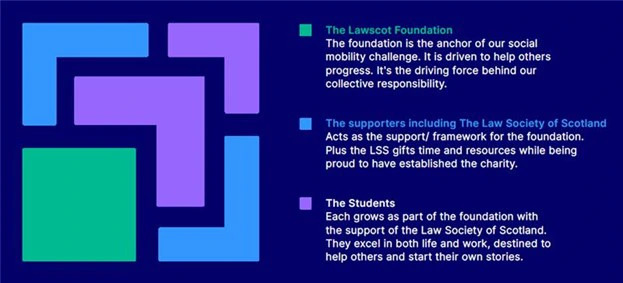
New logo supports Lawscot Foundation’s barrier breaking mission

New logo supports Lawscot Foundation’s barrier breaking mission

The Lawscot Foundation has unveiled a modern new logo to help aid its mission supporting aspiring Scottish lawyers who face financial and other barriers.

The new look has been launched as 2025 applications for support are considered. Applications can be made up to midday on Monday, 30 June 2025 by pupils who meet the eligibility criteria, including having an offer to begin a Scots law LLB later this year.

New logo supports Lawscot Foundation’s barrier breaking mission

Lawscot Foundation chair Christine McLintock said: “I am delighted to launch a new logo and an updated website for our charity, and particularly to do so as we consider applications from talented aspiring solicitors who rely on our support to pursue their legal careers.

“It’s nearly 10 years since we launched the Lawscot Foundation, so this is a timely moment to update our branding to help us connect to eligible students and to attract and retain the sponsors who make our charity’s mission possible.

“We have kept the cost of these changes to an absolute minimum as we do with our administrative costs in general to ensure the Foundation’s finances can support as many deserving students as possible.

“Our support can change a student’s life, opening up the possibility of a career that can also change the legal sector for the better. To anyone eligible, I’d strongly encourage you to apply before the end of June!

“We can’t thank our generous sponsors and students enough for their support. The trustees and I are looking forward to seeing this rolled out and welcoming the next cohort of scholars later this year.”

Review: One lawyer’s inspiring fight against Big Asbestos

By Tom Marshall

Review: One lawyer's inspiring fight against Big Asbestos

The history of the harms caused by asbestos is a long and painful one. Since the start of the large-scale commercial exploitation of the mineral in the 19th century, evidence of its damaging effects has been noted and well documented.

In the United Kingdom diseases caused by dust exposure were among the most important drivers of the regulation of working conditions in workshops, factories and mines. The particular problems caused by asbestos exposure saw industry-specific legislation by the 1930s.

Notwithstanding these measures plus persistent government warnings and growing medical research revealing the long-term or fatal damage which could be caused by exposure to asbestos dust, the businesses which had been built on the development of ever more uses and products based on asbestos continued to insist that these products were safe.

By the 1960s, at a time when public awareness of the problems with asbestos began to develop, the UK companies which controlled the industry were so profitable that a Monopolies and Mergers Commission investigation was instituted to examine competition in the asbestos market. Ironically, by the time it reported the companies had already realised that the tide of opinion was flowing against asbestos and had begun to research alternatives.

Among these companies was Cape Asbestos, a huge vertically integrated organisation controlling asbestos mining and manufacturing as well as supply and installation of products. For example, in Scotland by the 1960s it operated factories in Glasgow, making asbestos insulation board especially for the shipbuilding industry, and Stirling, making slab insulation for engineering, together with a contracting company installing and maintaining asbestos insulation in public, industrial and commercial premises.

However, it was from South Africa, where the asbestos was mined, that the true extent of the harms which could be caused by asbestos had begun to emerge. Cape operated mines in two areas of the country. In the Northern Cape they had crocidolite (known as blue asbestos) and in the Northern Transvaal, now known as Limpopo, they had amosite (known as brown asbestos). By the 1950s medical practitioners in these areas had begun to observe the emerging frequency of an otherwise rare type of cancerous tumour, known as mesothelioma, affecting in particular the lining of the chest wall and lungs. This cancer was seen not just in asbestos miners but also in the workers who prepared the mineral on the surface and in family members of the workforce living in the villages next to the mines. A report on case studies of some of those affected was published in the British Journal of Industrial Medicine in 1960. Almost immediately this attracted attention among doctors in countries where the use of asbestos in industry was widespread.

International conferences were convened. At last, the dangers of asbestos from even limited exposure began to be recognised. By 1970 crocidolite had effectively been withdrawn from further use and tighter regulations attempted to impose reductions in exposures in the UK workplace.

Back in South Africa, however, little or nothing was done to improve the conditions in the mines, mills and villages. Under the apartheid regime the black and coloured (i.e. mixed race and Asian) communities received little or no protection and medical care. Cape and other mining companies continued to operate much as before.

David Kinley’s new book is subtitled “Death, Deceit and the Lawyer who Busted Big Asbestos” and tells the story of Richard Meeran, a young English solicitor of Indian descent and South African roots, who took up the plight of the mine and mill workers and their families in the mid-1990s. Cape had sold out its mining interests in South Africa in 1979.

Court action in South Africa against the local Cape subsidiaries was effectively impossible and would almost certainly have been fruitless. Meeran decided to try and obtain justice and redress for the victims against the parent company in England on the grounds that it had directed the operations and methods in South Africa in the knowledge that they were dangerous.

Through interviews with Meeran and many other lawyers, trade unionists, activists and medics as well as some of the victims themselves and their families, Kinley brings to life the extraordinary battle fought out in both South Africa and England, in and out of court. The human stories are set against the backdrop of the legal struggles ending in the House of Lords where the claimants finally defeated the various attempts by Cape and its lawyers to have the case (Lubbe and others v Cape) dismissed.

A Rain of Dust: Death, Deceit and the lawyer Who Busted Big Asbestos, by David Kinley. Published by John Hopkins University Press, 387pp, £22.50.

Rights watch

Rights watch

A round-up of human rights stories from around the world.

Dozens injured by Israeli gunfire as crowds overwhelmed Gaza aid site, UN says

The UN Human Rights Office has said it believes 47 people were injured in Gaza on Tuesday when crowds overwhelmed an aid distribution centre run by a controversial new group backed by the US and Israel.

Portugal’s far-right Chega becomes main opposition party

Portugal’s far-right, anti-establishment party Chega overtook the centre-left Socialists to become the main opposition party for the first time on Wednesday after the final tally of ballots from abroad in a May 18 snap parliamentary election.

Council of Europe chief warns against politicising court of human rights

Alain Berset says no judiciary should face political pressure after nine countries make intervention over migration.

Saudi Arabia placing women in ‘rehabilitation jails’

Saudi Arabia is placing women accused of being disobedient in care facilities with prison-like conditions to “rehabilitate” them, according to women who have spoken out about their experiences.

Amnesty, 4 other groups call on Pakistan to end crackdown on human rights defenders in Balochistan

Amnesty International and four other human rights organisations called on Pakistan to release human rights defenders in Balochistan and end the crackdown on dissent, according to Amnesty’s website.

Sick and forgotten: The lives of over 100 Russian political prisoners are in danger

The UN and NGOs report that more than 120 dissidents are seriously ill in prison.

Manufacturing of an ‘antinational’ in India

Police, media and courts converge to turn a Muslim scholar into a threat – on the flimsiest of words and the strongest of biases.

China accused of ‘indoctrinating’ Tibetan children from age of four with state-run boarding schools

Rights activists have accused Chinese authorities of indoctrinating Tibetan children and eroding their culture by forcing them to attend “colonial” boarding schools.

‘Tortured’ Ugandan activist dumped at border following arrest in Tanzania

East African rights groups condemn Tanzania, saying human right activists ‘abandoned’ at border show signs of torture.

A basketball player was sidelined for her headscarf. France may now ban them in all sports.

Thousands of young Muslim women in France are sidelined from competitive sport because rules in several disciplines ban uniforms and other clothing carrying a religious or political significance.

Tokyo hotel sued for denying stay to Korean resident of Japan over refusal to use Japanese name

A Tokyo hotel is facing legal action after refusing accommodation to a Korean-Japanese woman who declined to use a Japanese name instead of her Korean name.

Quote of the day

Remember also that the smallest minority on earth is the individual. Those who deny individual rights, cannot claim to be defenders of minorities.

Ayn Rand, ‘Capitalism: The Unknown Ideal’ (1966)

And finally… I fought the claw

And finally... I fought the claw

Credit: Da Parinda Pakeesuk / Facebook

A lost cat rescued by police was spared jail despite scratching the officer involved and going through a light-hearted “arrest”.

Bangkok police officer Da Parinda Pakeesuk shared photos of the tiny British shorthair on Facebook as he appealed for its owner to collect the cat from his station.

First, however, he insisted on booking the cat for “attempting to subdue an officer” after suffering scratches during his brave rescue.

Mr Pakeesuk said he was happy to release the pet on “bail” after his delighted owners arrived at the station.

“A urine test showed no catnip in his urine,” he joked. “See you at the World Cat Court!”

Executry Software: Why Law Firms Face Delays and How Legal Case Management Software Can Help

Executry Software: Why Law Firms Face Delays and How Legal Case Management Software Can Help

Scotland’s legal sector is under increasing pressure as demand for executry and estate administration services grows, but many firms are still battling with outdated systems and manual processes. With over 64,000 deaths annually in Scotland alone and estates often involving multiple institutions, the administrative burden is heavier than ever. More than half of legal professionals report resource shortages, while outdated workflows and manual paperwork continue to slow progress, reduce profitability, and impact client satisfaction. Yet, a solution is within reach.

Modern legal software with built-in executry management tools offers a clear path forward - streamlining processes, reducing burnout, and improving both operational efficiency and client service.

Read on to discover how the right case management system can help your firm meet growing demands and allow you to deliver a better service to grieving families .

Read the full blog here.

In Case You Missed It...

Please note that Scottish Legal News accepts no responsibility for viruses. It's your responsibility to scan attachments.

Scottish Legal News strives to be accurate. If you see anything in our publication which is misleading or wrong, please contact us.

You can find the most up-to-date information about how to contact Scottish Legal News on our website.

© E-News Now Ltd 2026
You are receiving this email because you are subscribed to Scottish Legal News.